If you’ve compared specs across different power station brands, you’ve probably noticed that some models advertise “LiFePO4” batteries as a selling point, while others (often cheaper or older models) use standard lithium-ion (NMC). The difference isn’t just marketing language — it directly affects how long your power station will last, how safe it is, and how much it weighs. Here’s what you actually need to know before choosing.
The Short Answer
LiFePO4 (Lithium Iron Phosphate) batteries last significantly longer (often 3,000+ charge cycles vs. 500–1,000 for standard lithium-ion), run cooler, and are considered safer due to their more stable chemistry. Lithium-ion (NMC) batteries are lighter and more compact for the same capacity, but degrade faster and carry a slightly higher risk of overheating under stress.
For most buyers planning to keep a power station for several years, LiFePO4 is the better long-term choice — which is why it has become the standard in newer, higher-end models.
What’s Actually Different Inside the Battery
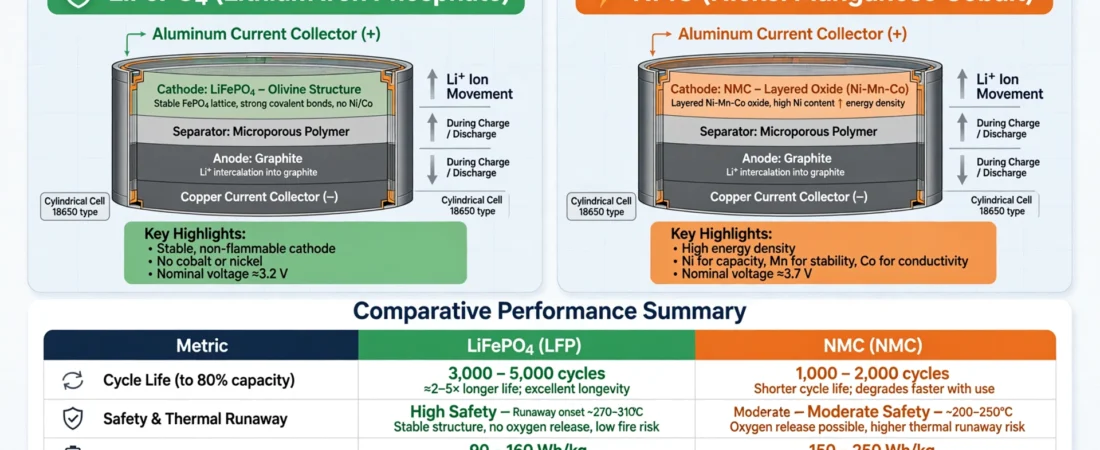
Both LiFePO4 and standard lithium-ion (often labeled NMC, for Nickel Manganese Cobalt) are technically lithium-ion battery chemistries — LiFePO4 is a specific subtype. The difference comes down to the cathode material used:
- NMC batteries use a cathode combining nickel, manganese, and cobalt, which allows for very high energy density (more power stored in a smaller, lighter package) but is more chemically reactive and prone to thermal runaway under extreme stress.
- LiFePO4 batteries use an iron phosphate cathode, which is chemically more stable and doesn’t release oxygen as readily when damaged or overheated, significantly reducing fire risk.
Side-by-Side Comparison
| LiFePO4 | Standard Lithium-ion (NMC) | |
|---|---|---|
| Typical charge cycle lifespan | 2,500–4,000+ cycles | 500–1,000 cycles |
| Thermal stability | High — resistant to thermal runaway | Lower — more prone to overheating under stress |
| Energy density | Lower (bulkier/heavier per Wh) | Higher (lighter/more compact per Wh) |
| Typical lifespan (daily use) | 7–10+ years | 2–4 years |
| Cost | Slightly higher upfront | Slightly lower upfront |
| Common use case | Home backup, long-term ownership | Ultralight/compact travel units |
Why Charge Cycles Matter More Than Most Buyers Realize
A “charge cycle” is one full discharge-and-recharge of the battery (using 100% of its capacity, whether in one session or spread across several partial charges). This number directly determines how long your power station will remain useful before its capacity noticeably declines.
Here’s the practical impact: if you use your power station roughly once a week, a 500-cycle NMC battery could start showing meaningful capacity loss within about 10 years — but if you use it several times a week (common for full-time RV or off-grid living), that same battery could degrade within 2–3 years. A LiFePO4 battery rated for 3,000+ cycles under the same heavy usage pattern would still have years of useful life remaining.
Is NMC Actually Bad? Not Necessarily
NMC isn’t a “bad” battery chemistry — it’s a tradeoff. Its higher energy density means manufacturers can build lighter, more compact power stations for the same capacity, which matters for backpackers, photographers, or anyone prioritizing portability above all else. If you’re buying a smaller unit primarily for occasional trips rather than daily or weekly use, the faster degradation of NMC may never actually become a practical issue for you.
Which Should You Choose Based on Your Use Case?
Choose LiFePO4 if:
- You plan to use the power station regularly (weekly or more)
- You want the unit to last 7+ years without meaningful performance loss
- You’re buying for home backup, where the unit may sit charged for long periods between uses (LiFePO4 handles long-term storage at partial charge better)
- Safety is a top priority (indoor use, use near sleeping areas, RV installation)
LiFePO4 has become common enough that it’s the better default even for occasional use, unless weight is your absolute top priority — most major brands (Jackery, EcoFlow, Anker SOLIX, Bluetti) have shifted their newer flagship lines to LiFePO4 for exactly this reason.
Consider standard lithium-ion (NMC) only if:
- You need the absolute lightest, most compact unit possible (ultralight backpacking, air travel)
- You’ll use it infrequently (a few times a year)
- Budget is the primary constraint and you’re comfortable replacing the unit sooner
How to Check Which Battery Type a Power Station Uses
Battery chemistry isn’t always front and center in marketing material, but it’s almost always listed in the full specification sheet, usually under “Battery Type” or “Cell Chemistry.” As a quick rule of thumb: nearly all power stations released since around 2022 by major reputable brands (Jackery, EcoFlow, Anker SOLIX, Bluetti) use LiFePO4 for their mid-size and large units, while some ultra-compact or older budget models still use NMC. If it’s not listed clearly, check the manufacturer’s product page or contact customer support before buying — this is one spec worth confirming, not assuming.
Frequently Asked Questions
Does LiFePO4 charge slower than lithium-ion? Not inherently — charging speed is determined more by the inverter and charging circuitry design than by battery chemistry alone. Many LiFePO4 units now support fast-charging just as quickly as NMC models.
Is LiFePO4 heavier? Yes, generally. LiFePO4 has lower energy density, so a LiFePO4 battery storing the same watt-hours as an NMC battery will typically weigh 10–20% more. This is the main tradeoff for its longer lifespan and improved safety.
Can I tell battery type just by price? Not reliably. While LiFePO4 units are often priced slightly higher, price is influenced by many factors (brand, capacity, features). Always check the actual spec sheet rather than assuming based on price alone.
Do LiFePO4 batteries really not catch fire? No battery chemistry is completely risk-free, but LiFePO4 is significantly more thermally stable than NMC and is much less likely to enter thermal runaway (the chain reaction that causes battery fires) even when damaged, overcharged, or exposed to high heat.
Final Thoughts
If you’re buying a power station you plan to rely on for years — whether for home backup, RV living, or frequent camping — LiFePO4 is worth prioritizing, even at a slightly higher upfront cost. The extended lifespan alone (often 3-5x more charge cycles) usually makes it the better value over time, not just the safer choice.
Ready to compare specific LiFePO4 models? Check out our complete guide to the best portable power stations to see our top picks, all clearly labeled by battery chemistry.
Battery cycle ratings are manufacturer specifications and represent the point at which capacity typically drops to around 80% of original — batteries remain usable beyond this point, just with reduced total capacity.