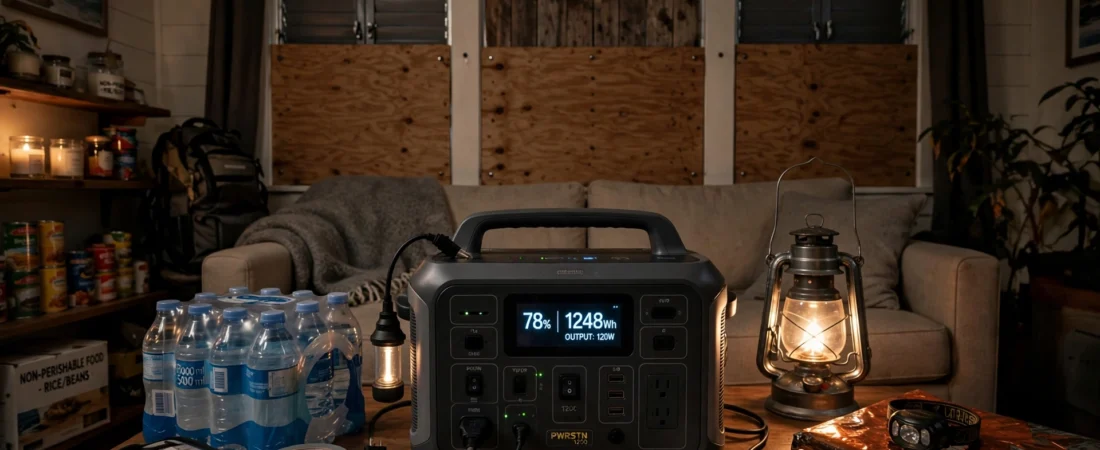
Hurricane season brings a specific kind of power outage risk: not a quick, hours-long blip, but potentially days or even weeks without reliable grid power, often combined with heat, humidity, and limited access to fuel for traditional generators. This guide covers exactly what to prioritize when choosing a power station for hurricane preparedness, and our top picks for storm season.
Quick Answer: Our Top Hurricane Prep Picks
| Power Station | Best For | Capacity | Approx. Price |
|---|---|---|---|
| Anker SOLIX C1000 Gen 2 | Essential circuits, fast recharge between storms | ~1,024Wh | $450–$500 |
| EcoFlow DELTA 3 Plus | Fastest recharge during rolling outages | ~1,024–1,200Wh | $600–$700 |
| EcoFlow DELTA 3 MAX Plus | Extended multi-day outages, whole-home partial backup | ~4,096Wh (expandable) | $2,500–$3,200 |
| ECOFLOW DELTA 3 Classic | Best value for solid mid-size backup | ~1,024Wh | $550–$600 |
Prices fluctuate frequently with sales events, so always check the current price before buying.
Why Hurricane Prep Is a Different Planning Problem
Most power outage guidance assumes a few hours without power. Hurricane season is different for three specific reasons:
- Outages can last days, not hours. Depending on storm severity and grid damage, restoration can take anywhere from a day to several weeks in severely affected areas.
- Fuel becomes scarce and dangerous to store. Gas stations often run dry before and after major storms, and stockpiling gasoline at home carries real fire risk, especially in a storm-damaged structure.
- Heat makes refrigeration and cooling non-negotiable. Unlike a winter outage where losing heat is the primary concern, hurricane season outages often mean losing refrigeration and any cooling capability during peak summer heat — a genuine health risk, particularly for elderly residents or anyone with health conditions.
This combination is exactly why solar generators have become a core part of hurricane preparedness for many coastal households: no fuel to stockpile, safe to run indoors, and rechargeable via solar even if grid power and gas stations are both unavailable for an extended period.
What to Prioritize for Hurricane-Specific Prep
Fast AC Recharge (Before the Storm and Between Grid Restoration Windows)
The single most valuable spec for hurricane prep is AC recharge speed. In the run-up to a storm, you often have limited notice — sometimes just a day or two — to fully charge your unit. During the outage itself, brief windows of grid restoration sometimes occur before power fails again; a fast-charging unit can top off during that window, while a slow-charging unit may not.
Solar Recharge Capability
If the outage extends beyond your battery’s initial charge, solar panels become your only realistic recharge method if grid power and fuel are both unavailable. Pairing your power station with a solar panel rated for reasonably fast charging (100-200W minimum for smaller units, 400W+ for larger systems) is one of the most important hurricane-specific investments you can make. See our guide on charging with solar panels for setup details.
Enough Capacity for Multi-Day Essential Use
Unlike a typical short outage, hurricane prep should be planned around several days of essential circuit use, not just a few hours. Realistically size your capacity around your refrigerator, some lighting, phone charging, and any medical equipment running for multiple days, ideally supplemented by daytime solar recharge. See our guide on how many watts you need for a detailed capacity calculation.
Portability for Potential Evacuation
If you’re in an evacuation zone, your power station may need to travel with you, not just sit in your home. A unit in the 1,000-2,000Wh range strikes a reasonable balance between meaningful capacity and something you can still load into a vehicle quickly if needed.
Top Picks Explained
Best for Fast Recharge Between Storms: Anker SOLIX C1000 Gen 2
With a recharge time of roughly 58 minutes to full and strong 1,800W continuous output, the C1000 Gen 2 lets you top off quickly in the narrow window before a storm hits, and its UPS-style switchover helps keep sensitive electronics running seamlessly if grid power fails unexpectedly.
Best for Rolling Outages: EcoFlow DELTA 3 Plus
For hurricane-prone areas where power sometimes flickers back on briefly before failing again, the DELTA 3 Plus’s roughly 43-minute recharge to 80% via X-Stream charging is specifically valuable for catching those brief restoration windows before the next outage hits.
Best for Extended, Multi-Day Outages: EcoFlow DELTA 3 MAX Plus
For households wanting genuine multi-day coverage of a refrigerator plus additional circuits, and the option to expand toward broader home backup, the DELTA Pro 3’s much larger base capacity and expandability puts it in a different class from compact units, though it comes at a significantly higher price point.
Best Value Pick: ECOFLOW DELTA 3 Classic
At around $599 with 1,024Wh capacity and a 45-minute recharge to 80%, the Classic offers strong hurricane-prep capability without the premium price of some competitors, making it a solid choice for households wanting genuine backup without maximizing budget.
A Hurricane Season Power Prep Checklist
- Charge your power station to 100% as soon as a storm watch is issued for your area
- Test that your solar panel connects and charges properly before the storm arrives, not during it
- Identify your true essential circuits in advance (refrigerator, medical equipment, phone charging, some lighting) rather than deciding mid-outage
- Keep your power station and any solar panels in a safe, accessible, dry location — not somewhere that could flood
- If evacuating, bring your power station with you rather than leaving it behind
- After the storm, avoid leaving your power station in direct sun or a hot car for extended periods, which can accelerate battery wear
Frequently Asked Questions
How long will a power station keep my refrigerator running during a multi-day hurricane outage? A 1,000Wh unit can typically sustain intermittent refrigerator operation for roughly 15-20 hours on a single charge, given how compressors cycle on and off rather than running continuously. For true multi-day coverage, pairing your unit with solar panels for daytime recharging is essential — see our 1000Wh runtime guide for detailed estimates.
Is it safe to run a power station during a hurricane if my home floods? No — like any electrical equipment, keep your power station away from standing water and never operate it in wet conditions. If flooding is a risk in your area, keep your unit elevated and in the driest, safest part of your home, or take it with you if evacuating.
Should I buy a gas generator instead for hurricane prep? Many hurricane-prone households use both, but a solar generator has distinct advantages for this specific use case: no fuel to stockpile or run out of, safe to run indoors during storms when going outside isn’t practical, and silent operation. A gas generator can provide more raw power for whole-home needs but comes with fuel storage risk and requires safe outdoor operation.
How far in advance should I charge my power station before a storm? As soon as a hurricane watch or warning is issued for your area — don’t wait until the last minute, since store shelves and charging infrastructure can become unpredictable as a storm approaches.
Final Verdict
For most households in hurricane-prone areas, the Anker SOLIX C1000 Gen 2 or Bluetti AC180 provide strong essential-circuit coverage with fast recharge capability at an accessible price. Households wanting genuine multi-day, broader coverage should consider the EcoFlow DELTA Pro 3, ideally paired with a solar panel setup for sustained recharging during extended outages.
Want more general power outage planning guidance beyond hurricane season specifically? Check out our complete guide to preparing your home for a power outage.
Prices and specifications are approximate and subject to change. This guide is for general informational purposes — always follow official evacuation orders and guidance from local emergency management authorities during an actual storm event.
Affiliate Disclosure: This post contains affiliate links. If you purchase through one of these links, we may earn a small commission at no extra cost to you. We only recommend products we believe genuinely deliver value to readers.