This is, without question, the question we get asked most often — and it’s also where most first-time buyers make an expensive mistake. Buy too little wattage, and your power station won’t run the appliances you actually need. Buy too much, and you’ve overspent on capacity you’ll never use.
This guide walks you through exactly how to calculate your power requirements with real-world examples so you can buy with confidence.
First, Understand the Two Numbers on Every Power Station
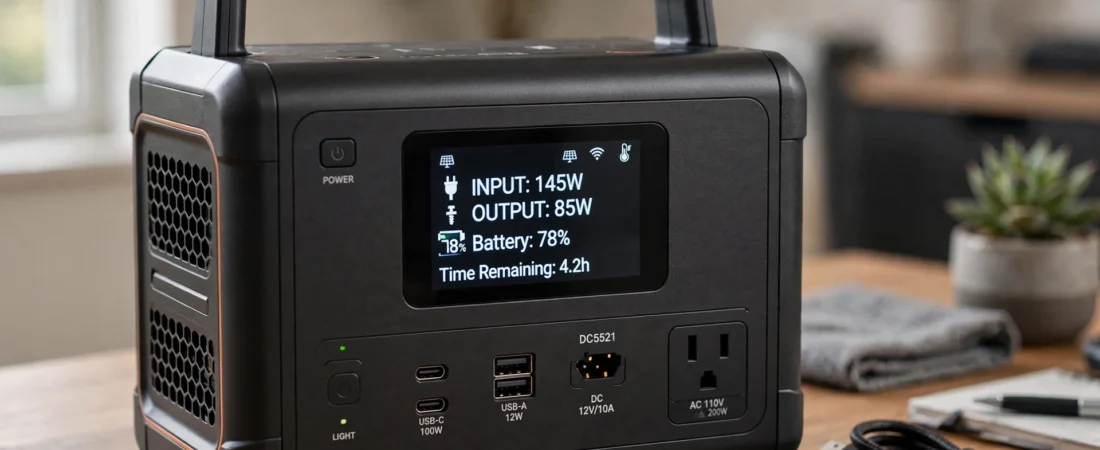
Every power station lists two separate specifications, and confusing them is the single biggest mistake buyers make:
- Watts (W): How much power the unit can deliver at one moment in time. This determines what appliances you can physically run.
- Watt-hours (Wh): How much total energy the unit can store. This determines how long you can run those appliances.
💡 The Water Analogy: Think of watts as the width of a water pipe, and watt-hours as the size of the water tank. A wide pipe (high wattage) lets a lot of water flow out quickly, allowing you to run demanding appliances like a microwave. A big tank (high Wh) means you can keep that water flowing for a long time before running dry.
You need both numbers to be right for your situation. A power station can have a massive Wh capacity but still fail to run a specific appliance if its continuous wattage output is too low.
Step 1: List Everything You Want to Power
Grab a notepad and list every device or appliance you would realistically want to run at the same time. Most appliances have their wattage printed on a safety label (often near the plug, or on the bottom/back of the unit) or listed clearly in the product manual.
Common Household & Camping Appliance Wattages
| Device | Running Watts | Starting Watts (Surge) |
|---|---|---|
| Smartphone charger | 5–20W | — |
| Laptop | 30–100W | — |
| LED light bulb | 5–15W | — |
| WiFi router | 10–20W | — |
| CPAP machine | 30–60W | — |
| Mini fridge | 50–100W | 200W |
| Full-size refrigerator | 100–200W | 800–1,200W |
| Box fan | 50–100W | — |
| Electric cooler | 40–60W | — |
| Coffee maker | 800–1,200W | — |
| Microwave | 600–1,200W | — |
| Space heater | 1,000–1,500W | — |
| Hair dryer | 1,000–1,800W | — |
| Power drill | 500–800W | 1,000W |
| Window AC unit | 500–1,200W | 1,500–2,200W |
⚠️ Important Note: Appliances with motors or compressors (refrigerators, AC units, air conditioners, and power tools) require a short burst of extra power to start up — called starting watts or surge watts — before settling into their normal running watts. Your power station’s peak output rating must be able to handle that starting surge.
Step 2: Add Up Your Running Watts
Add together the running wattage of everything you plan to use at the same time. You don’t need to count appliances you will use one at a time and unplug before using the next — only what is drawing power simultaneously.
Example Scenario: Emergency Home Outage
- Refrigerator (running): 150W
- WiFi router: 15W
- 3x LED lights: 30W
- Smartphone charging: 20W
- Total Requirements: 215W running, with a refrigerator start-up surge of up to 1,200W.
This baseline tells you two things: you need a power station rated for at least 1,200W peak/surge output (to survive the fridge’s startup) and one comfortably able to sustain 215W continuously.
Step 3: Match to a Power Station Category
Here is a simple reference guide for matching your calculated total wattage needs to the right power station tier:
- Under 300W Total (Phones, laptops, small lights, CPAP): A compact 300–600Wh power station with a 300–600W output is usually more than enough.
- 300W–800W Total (Add a mini fridge, fan, or coffee maker): Look for a 1,000Wh-class unit with at least 1,000–1,800W output capacity.
- 800W–2,000W Total (Multiple appliances, power tools, microwave): You will want a heavy-duty 2,000Wh-class unit featuring a 2,000–3,000W output inverter.
- 2,000W+ Total (Space heaters, full-size AC, whole-home partial backup): Consider a 3,000Wh+ expandable ecosystem with a 3,000W+ continuous output option.
Step 4: Calculate the Expected Runtime
Once you know your wattage needs, you can use the watt-hour rating to estimate your total runtime. The standard math formula is straightforward:
Runtime (Hours)=Total Running WattsBattery Capacity (Wh)
Applying the Formula
If you run our 215W emergency home outage scenario on a 1,000Wh power station:
1,000 Wh÷215 W≈4.6 Hours of continuous runtime
Note: This is a mathematical estimate. Real-world runtime is usually 10% to 15% lower due to power consumption from inverter efficiency losses (most standard models operate at 85–95% efficiency). Conversely, cyclic appliances like refrigerators cycle on and off automatically, which naturally extends real-world runtime beyond a flat mathematical division.
Common Mistakes to Avoid
- Mistake #1: Only checking watt-hours and ignoring wattage output. A power station with a massive battery capacity but a weak internal inverter (common in budget clone brands) won’t be able to turn on a refrigerator or run a microwave, no matter how much energy it holds stored inside.
- Mistake #2: Forgetting about starting/surge watts. Many buyers add up running numbers and are surprised when their system shuts down or displays an error code the moment a refrigerator compressor kicks in. Always check the peak/surge output metric.
- Mistake #3: Sizing exactly to your current needs. It is tempting to buy a unit that perfectly matches your current math, but under-buying often means running into limits later. It is generally smarter to size your power station 20% above your calculated threshold.
Final Thoughts
Finding the right power station wattage comes down to a simple process: list your simultaneous electronics, add their running wattages, check for peak surge requirements, and select a system that clears that total comfortably.
Not sure which specific model fits your calculated wattage needs? Check out our complete guide to [the best portable power stations of 2026] to see our top verified field picks by capacity, reliability, and budget.
Appliance wattages listed above are approximate averages. Always check the specific manufacturing label on your physical devices before operating, as power specifications vary across brands and production years.