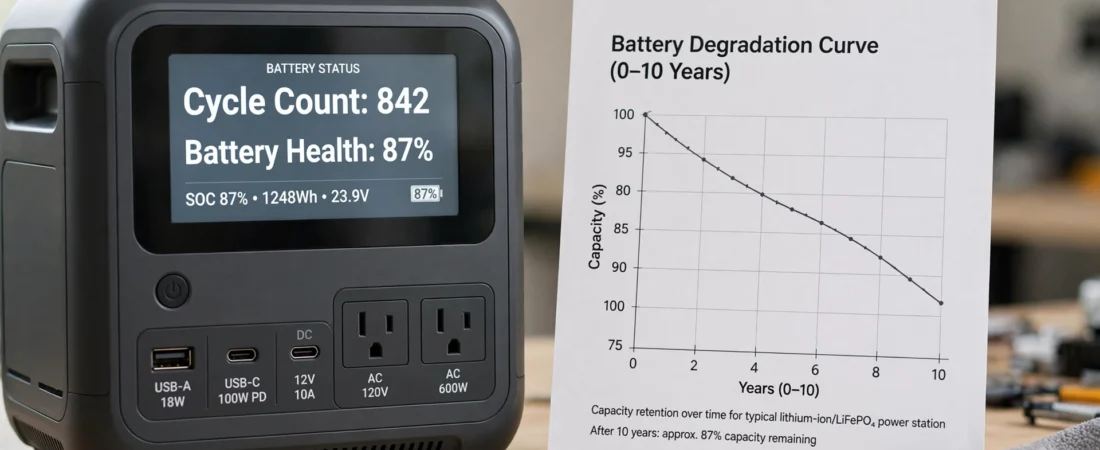
“How long will this actually last me?” is one of the most important questions to answer before spending several hundred (or several thousand) dollars on a power station — and it’s also one of the most misunderstood. The answer depends on a concept called “charge cycles,” not simply years on a calendar. This guide breaks down exactly what that means and what kind of lifespan you can realistically expect.
The Short Answer
Most modern power stations last somewhere between 3 and 10+ years, depending primarily on battery chemistry (LiFePO4 vs. standard lithium-ion) and how frequently you use and recharge the unit. A LiFePO4 power station used a few times a month can realistically last well over a decade, while a standard lithium-ion unit used daily might show noticeable capacity decline within 2-3 years.
What Is a “Charge Cycle,” Exactly?
A charge cycle is one complete discharge-and-recharge of the battery, using 100% of its capacity — but it doesn’t need to happen in a single session. If you use 50% of your battery on Monday and recharge it, then use another 50% on Tuesday and recharge again, that counts as one full charge cycle, not two.
Every rechargeable battery has a limited number of charge cycles before its capacity begins to noticeably decline. Manufacturers typically rate this as the number of cycles until capacity drops to around 80% of original — the battery doesn’t stop working at that point, it simply holds a bit less charge than when new.
Charge Cycle Ratings by Battery Type
| Battery Chemistry | Typical Rated Cycles | Approximate Real-World Lifespan |
|---|---|---|
| Standard Lithium-ion (NMC) | 500–1,000 cycles | 2–4 years (regular use) |
| LiFePO4 | 2,500–4,000+ cycles | 7–10+ years (regular use) |
(For more detail on the difference between these two chemistries, see our full Lithium-ion vs LiFePO4 comparison.)
Turning Charge Cycles Into Real Years
The math is simple once you know your usage pattern:
Estimated Years of Life = Rated Charge Cycles ÷ Cycles Used Per Year
Example 1: Occasional Camper If you use your power station about once a month (roughly 12 full cycles per year), a LiFePO4 unit rated for 3,000 cycles would theoretically last 250 years worth of cycles — in practice, other factors (like general wear, connector durability, or simply newer technology becoming available) will make the unit “outdated” long before the battery itself is the limiting factor.
Example 2: Frequent RV or Off-Grid User If you’re recharging daily (365 cycles per year), a LiFePO4 unit rated for 3,000 cycles would last roughly 8 years before dropping to around 80% capacity — still very solid for daily use. The same daily usage pattern on a 500-cycle NMC battery would show meaningful decline in about 1.4 years.
Factors That Affect Lifespan Beyond Charge Cycles
Charge cycle rating is the main factor, but a few other variables meaningfully affect how long your power station lasts in practice:
Storage Habits
Leaving a battery fully charged (100%) or fully depleted (0%) for extended periods accelerates degradation in most lithium battery types. Most manufacturers recommend storing a power station at around 50-70% charge if it won’t be used for several months, and topping it off periodically (roughly every 3 months) during long-term storage.
Temperature Exposure
Heat is one of the fastest ways to degrade any lithium battery. Leaving a power station in a hot car trunk or direct summer sun regularly will shorten its lifespan more than normal indoor use, regardless of battery chemistry.
Charging Habits
Using fast-charging modes constantly (rather than occasionally) tends to generate more heat during charging, which can modestly accelerate wear over time compared to standard-speed charging. This isn’t a reason to avoid fast charging altogether — just something to be aware of if you have the option to charge more slowly for units that will sit unused afterward.
Depth of Discharge
Consistently draining a battery to 0% before recharging tends to cause slightly more wear than partial discharges (for example, using 30-50% before topping back up). This matters more for NMC batteries; LiFePO4 chemistry handles full discharges considerably better.
Signs Your Power Station’s Battery Is Wearing Down
- Noticeably shorter runtime for the same devices compared to when the unit was new
- Longer recharge times than the manufacturer’s original specification
- The battery percentage display dropping unusually fast under light loads
- The unit feeling warmer than usual during charging or use
None of these signs mean the unit is unsafe to use — they simply indicate normal aging, and you should begin planning for eventual replacement rather than assuming something is broken.
Does the Warranty Tell You Anything About Expected Lifespan?
Yes, indirectly. Most manufacturers offer warranties that roughly reflect their confidence in the battery’s real-world lifespan:
- Budget/NMC units: typically 1-2 year warranties
- Mid-range LiFePO4 units: typically 3-5 year warranties
- Premium LiFePO4 units: some brands now offer 5-6 year warranties, occasionally extendable through registration
A longer warranty is generally a reasonable (though not perfect) proxy for how long the manufacturer expects the battery to perform well.
How to Maximize Your Power Station’s Lifespan
- Store at 50-70% charge if unused for extended periods, and check every few months
- Avoid leaving it in direct sun or hot vehicles when not in use
- Use standard charging speed rather than fast-charging when you’re not in a hurry
- Keep firmware updated if your model has a companion app — manufacturers occasionally release battery management improvements
- Avoid letting the battery sit at 0% for long periods before recharging
Frequently Asked Questions
Do power stations “die” suddenly, or fade gradually? Almost always gradually. Lithium batteries don’t typically fail all at once — you’ll notice slowly shrinking runtime and capacity over months or years, giving you plenty of time to plan a replacement before the unit becomes unusable.
Can I replace just the battery instead of buying a whole new unit? It depends on the brand and model. Some manufacturers sell replacement battery packs or modules (especially for expandable systems), while many all-in-one units are not designed for battery replacement, making a full unit replacement the more common outcome.
Does unplugging solar panels when not in use extend battery life? It has a minor effect at most — the bigger factors are storage charge level, temperature, and total charge cycles rather than how the unit is charged day-to-day.
Is it normal for a 3-year-old power station to hold less charge than when new? Yes, this is expected and normal battery aging, not necessarily a defect — the rate of decline depends heavily on the battery chemistry and usage pattern discussed above.
Final Thoughts
A power station’s real-world lifespan comes down to a simple equation: battery chemistry (LiFePO4 lasting roughly 3-5x longer than standard lithium-ion) combined with how often you actually use and recharge it. For anyone planning regular use — RV living, frequent camping, or reliable home backup — investing in a LiFePO4 model will very likely save you money over the years, even with a higher upfront price.
Want to see which current models offer the longest-lasting batteries? Check out our complete guide to the best portable power stations for our top picks, all clearly labeled by battery chemistry and warranty length.
Charge cycle ratings are manufacturer specifications based on standard testing conditions. Real-world lifespan varies based on usage patterns, storage conditions, and climate.