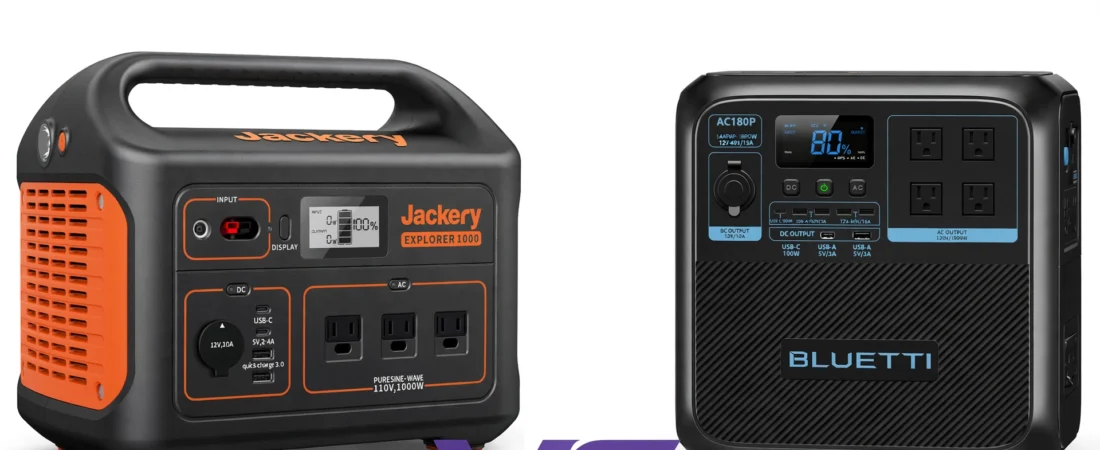
Bluetti has spent the past few years climbing from “value alternative” to a genuine top-tier competitor, and it’s now one of the most common brands buyers cross-shop against Jackery. The two brands take clearly different approaches — one leans on brand trust and portability, the other on raw specs and price. Here’s the full comparison.
Quick Answer
Choose Bluetti if you want the best price-per-watt-hour in the category, LiFePO4 battery chemistry across virtually the entire lineup, and faster charging on comparable units. Choose Jackery if you want the most polished, intuitive user experience, the lightest units in their class, and a more mature, purpose-built solar panel ecosystem.
Brand Overview
Jackery, founded in 2012, remains the most recognizable name in portable power stations, known for its orange-and-black Explorer series, user-friendly design, and a strong solar panel ecosystem built over more than a decade.
Bluetti, founded in 2019, positioned itself early as the value-focused challenger — consistently offering more capacity and features for less money, and moving aggressively to adopt LiFePO4 battery chemistry across its lineup well before it became standard industry-wide.
Head-to-Head: Entry to Mid-Range Comparison
| Spec | Jackery Explorer 300 | Bluetti Elite 30 V2 |
|---|---|---|
| Capacity | ~292Wh | ~288Wh |
| Continuous AC output | 300W | 600W (1,500W Power Lifting mode) |
| AC charge time (0–80%) | Several hours | ~45 minutes |
| UPS switchover | Not featured | 10ms UPS mode |
| Weight | ~7.5 lbs | ~9.4 lbs |
| Battery chemistry | LiFePO4 | LiFePO4 |
| Price | ~250$ | ~300$ |
At the entry tier, Bluetti’s advantage is significant: double the continuous output, dramatically faster AC recharge, and a dedicated UPS mode for seamless switchover during sudden outages — a feature Jackery doesn’t offer at this tier. Jackery’s edge here is purely on weight, where it remains noticeably lighter.
Head-to-Head: 1,000Wh–2,000Wh Class
| Spec | Jackery Explorer 1000 v2 | Bluetti AC70 |
|---|---|---|
| Approx. price | ~$550 | ~$400 |
| Battery chemistry | Mixed (newer models LiFePO4, older NMC) | LiFePO4 across the board |
| Charging speed | Slower | Faster |
| Price-per-Wh | Higher | Lower |
At this capacity tier, Bluetti’s value proposition becomes even clearer — comparable capacity at a meaningfully lower price, paired with guaranteed LiFePO4 chemistry. Jackery’s popular Explorer 1000 v2 specifically still ships with older NMC lithium-ion chemistry on some configurations, while Bluetti has standardized on LiFePO4 even in its budget-tier models.
Head-to-Head: Home Backup / High Capacity Class
| Spec | Jackery Explorer 2000 Plus | Bluetti AC200P |
|---|---|---|
| Base capacity | ~2,000Wh | ~2,000Wh |
| Expandable | Yes, up to ~24kWh | No |
| Battery chemistry | LiFePO4 | Older Li-NMC (this specific model) |
| Ports | Fewer | 17 ports, built-in wireless charging |
| Approx. price | ~$1900 | ~$1400 |
This tier presents the clearest tradeoff between the two brands: Jackery’s Explorer 2000 Plus offers genuine expandability and LiFePO4 chemistry, making it the stronger long-term investment for anyone planning to grow their system. Bluetti’s AC200P delivers similar base capacity at a significantly lower price with more ports, but lacks expansion capability and uses older battery chemistry in this specific model — worth checking carefully, since Bluetti’s chemistry varies more by model than Jackery’s newer lineup does.
Battery Chemistry: A Model-by-Model Question for Both Brands
This is one of the more nuanced parts of the comparison. Bluetti has moved aggressively to LiFePO4 across most of its lineup, including budget models — but some specific units (like the AC200P referenced above) still use older Li-NMC chemistry. Jackery has adopted LiFePO4 in its newer “Plus” and “Pro” models, but its popular Explorer 1000 v2 still ships with NMC in some configurations. The practical takeaway: don’t assume either brand’s chemistry based on reputation alone — check the specific model’s spec sheet every time.
Charging Speed: Bluetti’s Consistent Advantage
Across nearly every capacity tier compared, Bluetti models tend to charge noticeably faster via AC wall outlet than their closest Jackery equivalents — often reaching 80% in under an hour, compared to several hours for comparable Jackery units without a fast-charge mode. This is one of Bluetti’s most consistent advantages across its lineup.
Solar Charging and MPPT Performance: Bluetti’s Advantage
Bluetti has invested heavily in higher-range MPPT (Maximum Power Point Tracker) technology, which determines how efficiently a unit converts solar panel input into stored battery power. Bluetti’s higher-end models support a wider range of solar panel wattages, making the brand a particularly strong choice for buyers planning serious off-grid or RV solar setups.
Price-Per-Watt-Hour: Bluetti’s Clearest Strength
Averaged across comparable lineups, Bluetti consistently delivers a meaningfully lower cost per watt-hour than Jackery — a gap that’s especially noticeable in the popular 1,000–2,000Wh range where both brands compete directly. Jackery’s stronger brand recognition allows it to command a price premium; Bluetti competes primarily on specs and value.
User Experience and Ecosystem: Jackery’s Advantage
Jackery remains the more polished, intuitive brand to actually use day-to-day — its display panels, color-coded charging cables, and overall design consistently rate as more user-friendly in side-by-side testing. Its SolarSaga solar panel ecosystem is also more mature and purpose-built for outdoor use than Bluetti’s panel lineup, which is capable but less extensively developed.
Which Brand Should You Choose?
Choose Jackery if:
- You want the most polished, intuitive user experience
- Lightweight portability for camping and travel is a priority
- You’re buying a “Plus” or “Pro” model and want guaranteed LiFePO4 with expandability
- A mature, well-documented solar panel ecosystem matters to you
Choose Bluetti if:
- Price-per-watt-hour is your top priority
- You want the fastest AC charging speed at a given price point
- You’re planning a serious off-grid or RV solar setup and want strong MPPT performance
- You want a dedicated UPS mode for sensitive electronics (select models)
Frequently Asked Questions
Is Bluetti as reliable as Jackery, given Jackery’s longer track record? Bluetti has built a solid reputation since 2019 and is widely considered a legitimate, reliable brand — not simply a discount alternative. Jackery does have a longer overall track record and larger installed user base, which translates into more available real-world reliability data.
Does Bluetti’s lower price mean lower build quality? Not inherently — Bluetti’s lower price-per-watt-hour largely reflects a different market positioning and pricing strategy rather than reduced component quality. That said, always check the specific model’s chemistry and specs, since Bluetti’s lineup varies more between older and newer battery technology than some competitors.
Which brand is better for RV or off-grid living? Bluetti’s stronger MPPT performance and wider solar panel compatibility make it a strong choice for serious off-grid setups. Jackery’s expandable “Plus” models are also well-suited to this use case, particularly if you value its more mature solar ecosystem.
Can I mix Bluetti and Jackery accessories? No — solar panels and expansion batteries are proprietary to each brand’s connectors and specifications, so plan to stay within one ecosystem when building out your system.
Final Verdict
If price-per-watt-hour, charging speed, and guaranteed LiFePO4 chemistry are your top priorities, Bluetti is very difficult to beat, especially in the entry and mid-range tiers. If you want the most polished user experience, the lightest units, and a more mature solar ecosystem — and you’re specifically choosing one of Jackery’s newer “Plus” or “Pro” models — Jackery remains an excellent, well-proven choice. Neither brand will disappoint; the right pick depends on whether you prioritize raw value or refined user experience.
Curious how both brands compare to EcoFlow and Anker SOLIX as well? Check out our complete guide to the best portable power stations for the full brand-by-brand comparison.
Specifications and pricing are approximate and based on publicly available manufacturer data and independent testing as of 2026. Always verify current specs, chemistry, and pricing directly with the manufacturer before purchasing, since both brands’ lineups vary significantly by specific model.
Affiliate Disclosure: This post contains affiliate links. If you purchase through one of these links, we may earn a small commission at no extra cost to you. We only recommend products we believe genuinely deliver value to readers.