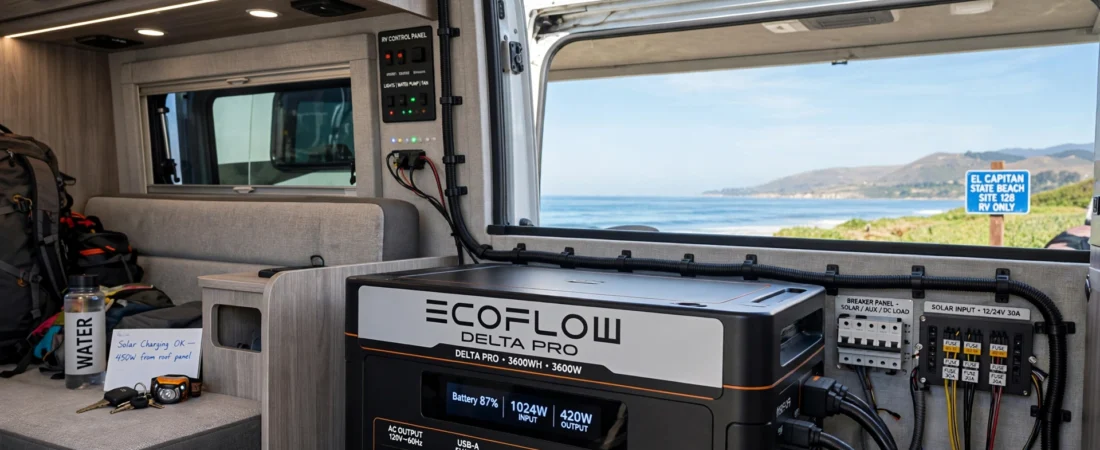
RV power needs sit in a different category entirely from weekend camping — you’re often running a fridge continuously, charging house batteries, and sometimes trying to run air conditioning or a microwave, all while boondocking away from hookups for days at a time. This guide breaks down exactly what to look for and our top picks for full-time and part-time RV living.
Quick Answer: Our Top RV Picks
| Power Station | Best For | Capacity | Continuous Output | Approx. Price |
|---|---|---|---|---|
| EcoFlow DELTA 2 | Best all-around for RVs | ~1,024Wh | 1,800W | $900–$1,000 |
| Anker SOLIX C1000 Gen 2 | Fast recharge at short stops | ~1,024Wh | 1,800W (2,400W surge) | $450–$500 |
| BLUETTI Elite 200 V2 | Extended boondocking, expandable | ~2,073Wh | 2,600W | $1,500–$1,800 |
| EcoFlow DELTA 3 MAX Plus | Serious power, partial AC use | ~4,096Wh | High continuous output | $2,500–$3,200 |
| Anker SOLIX F3800 | Heavy appliance use, EV-adjacent setups | 3,000–3,800Wh | Very high continuous output | $3,200–$3,800 |
What Matters Most for RV Use (Different from Camping or Home Backup)
Continuous Output for Compressor-Based Appliances
RVs typically run a full-size or RV-specific refrigerator continuously, which draws power around the clock rather than intermittently the way a home fridge cycles. Look for units with at least 1,500-1,800W continuous output if you plan to run a refrigerator alongside other electronics, and check the starting/surge wattage rating carefully — compressor startup can briefly demand far more power than the running wattage suggests.
Recharge Speed Matters More at Short Stops
If you’re moving between campgrounds frequently and only get short windows at hookups or generator time to recharge, a fast-charging unit like EcoFlow or Anker SOLIX becomes genuinely valuable — the difference between topping off in under an hour versus needing several hours can determine whether you actually arrive at your next stop with a full charge.
Solar Input for Boondocking
For full-time or extended boondocking (camping without hookups), solar recharge capability is often the deciding factor in day-to-day usability. Look at maximum solar input wattage carefully — higher-capacity units like the Bluetti AC200L and EcoFlow DELTA Pro 3 support significantly higher solar input than compact units, which matters when you’re relying on rooftop panels as your primary charging source.
Expandability for Growing Power Needs
Many RVers start with modest power needs and find them growing over time — adding an induction cooktop, upgrading to a larger fridge, or wanting AC backup. Choosing a unit with expansion battery compatibility from the start (EcoFlow DELTA series, Bluetti AC200L, Anker SOLIX F-series) avoids having to replace your entire system later.
Dedicated RV/Motorhome Outlets
Some higher-capacity units include a dedicated 30A RV-style outlet, which simplifies wiring directly into your RV’s existing electrical setup rather than running multiple smaller appliances off standard outlets individually. This is worth checking for if you plan to integrate the power station as a more permanent part of your RV’s system rather than using it as a portable, standalone unit.
Top Picks Explained
Best All-Around: EcoFlow DELTA 2
For most RVers, the DELTA 2 hits the right balance: 1,800W continuous output comfortably runs a refrigerator alongside charging devices and running smaller appliances, while EcoFlow’s X-Stream charging means you can top off quickly during short stops at hookups. Its expansion battery option also means you can grow capacity later without replacing the whole unit.
Why RVers choose it: Reliable continuous output, fast recharge, and a clear upgrade path if your needs grow.
Best for Frequent Short Stops: Anker SOLIX C1000 Gen 2
If your travel pattern involves moving often and only getting brief windows to recharge, the C1000 Gen 2’s roughly 58-minute recharge time is a genuine practical advantage — you can realistically top off during a lunch stop at a powered site rather than needing an overnight charge.
Why RVers choose it: Among the fastest recharge times available, minimizing downtime between travel days.
Best for Extended Boondocking: Bluetti AC200L
For RVers spending extended periods away from hookups, the AC200L’s roughly 2,048Wh base capacity (expandable well beyond 8,000Wh with add-on batteries), strong MPPT solar performance, and dedicated motorhome socket make it a purpose-built choice for serious off-grid RV use.
Why RVers choose it: Strong solar charging performance and genuine expandability for multi-day or multi-week boondocking stretches.
Best for Serious Power Needs: EcoFlow DELTA Pro 3
For RVers wanting to partially offset air conditioning use, run a microwave and coffee maker together, or generally treat their power station as a serious backup to (or partial replacement for) generator power, the DELTA Pro 3’s high base capacity and expandability toward whole-system capability puts it in a different class from compact units.
Why RVers choose it: Enough headroom to handle demanding, simultaneous appliance use without constantly monitoring output limits.
Best for Heavy Appliance / EV-Adjacent Setups: Anker SOLIX F3800
For RVers with especially demanding power needs — running power tools, larger appliances, or even contributing to EV charging at a campsite — the F3800’s very high continuous output is built to handle sustained heavy loads that would overwhelm smaller units.
Why RVers choose it: Genuine capability to run multiple high-draw appliances simultaneously without tripping output limits.
How Much Capacity Do You Actually Need for RV Use?
| RV usage pattern | Recommended capacity |
|---|---|
| Weekend RV trips, hookups available most nights | 1,000Wh |
| Regular RV use, occasional boondocking | 1,000–2,000Wh, expandable |
| Frequent or extended boondocking | 2,000–4,000Wh, expandable, with solar |
| Full-time RV living, running AC or heavy appliances | 3,000Wh+, expandable, with robust solar input |
Frequently Asked Questions
Can a portable power station run my RV’s air conditioner? Partially, and only with higher-capacity units. Running a typical RV AC unit (often 1,500-2,200W surge on startup) requires substantial continuous and surge output, and will drain even a large power station relatively quickly. Most RVers use portable power stations to supplement rather than fully replace AC power from shore power or a generator.
Do I need to hardwire the power station into my RV’s electrical system? No — most portable power stations are designed to be used as standalone units you plug appliances directly into, or plug into via extension cords. Some higher-capacity models offer dedicated RV outlets for more integrated setups, but hardwiring isn’t required for basic use.
How long will a 2,000Wh power station run my RV fridge? A typical RV compressor fridge draws roughly 40-60W on average when cycling normally, meaning a 2,000Wh unit can often sustain fridge operation alone for several days, though this drops significantly once you add other appliances and device charging into the mix.
Is solar charging realistic for full-time RV boondocking? Yes, with the right setup — pairing a higher-capacity power station with adequate rooftop or portable solar panels (typically 200-400W+ depending on your capacity needs) can realistically sustain moderate daily power use indefinitely in good sun conditions, though cloudy stretches will require supplemental charging via generator or shore power.
Final Verdict
For most RVers, the EcoFlow DELTA 2 offers the best overall balance of continuous output, fast recharge, and expandability without overspending on capacity you may not need yet. Full-time boondockers and those with heavier power demands should look toward the Bluetti AC200L or EcoFlow DELTA Pro 3 for the expanded capacity and stronger solar performance extended off-grid living requires.
Want to compare these RV picks against our overall brand rankings? Check out our complete guide to the best portable power stations for the full breakdown.
Prices and specifications are approximate and subject to change — always verify current pricing and specs directly with the manufacturer before purchasing.
Affiliate Disclosure: This post contains affiliate links. If you purchase through one of these links, we may earn a small commission at no extra cost to you. We only recommend products we believe genuinely deliver value to readers.