Affiliate Disclosure: This post contains affiliate links. If you purchase through one of these links, we may earn a small commission at no extra cost to you. We only recommend products we believe genuinely deliver value to readers.
Off-grid cabin living presents a different power challenge than camping or home backup — you need sustained, reliable power potentially indefinitely, not just for a weekend or a single outage. This guide covers how to plan a realistic system and our top picks for cabins ranging from weekend retreats to full-time off-grid living.
Quick Answer: Our Top Off-Grid Cabin Picks
| Power Station | Best For | Base Capacity | Expandable To | Approx. Price |
|---|---|---|---|---|
| Jackery Explorer 2000 v2 | Weekend/seasonal cabin | ~2,042Wh | Yes, with add-on packs | $700–$900 |
| Bluetti AC200L | Strong solar performance, mid-size | ~2,048Wh | 8,192Wh+ | $1,500–$1,800 |
| EcoFlow DELTA Pro 3 | Full-time off-grid living | ~4,096Wh | 25kWh+ | $2,500–$3,200 |
| Anker SOLIX F3800 | Heavy daily use, workshop/tools | 3,000–3,800Wh | Yes, system-buildable | $2,800–$3,500 |
What Matters Most for Off-Grid Cabin Use
This Is a System, Not a Single Purchase
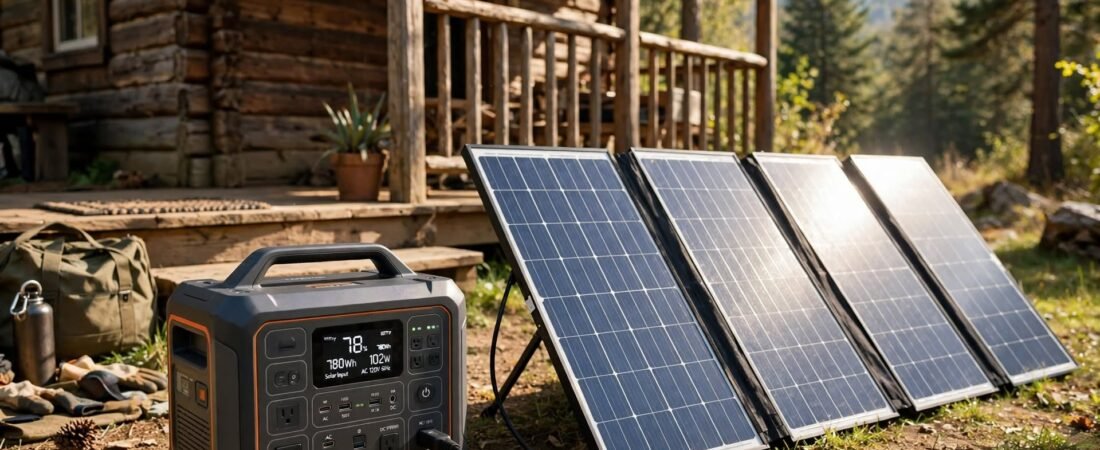
Unlike camping or CPAP use, a genuine off-grid cabin power setup usually means more than just buying “the biggest power station you can afford.” It typically involves the power station itself, a properly sized solar panel array, and realistic expectations about seasonal variation in sunlight. Treat this as designing a small system rather than a single product purchase.
Solar Array Sizing Is the Real Foundation
Your power station’s capacity determines how much you can store, but your solar panel wattage determines whether you can actually keep it charged day after day, indefinitely. As a rough starting point, most sustained off-grid cabin setups benefit from at least 400-800W of solar panel capacity paired with a 2,000Wh+ power station, though your exact needs depend heavily on your daily power consumption and regional sunlight availability. See our full guide on charging with solar panels for detailed sizing guidance.
Expandability Matters More Here Than Almost Any Other Use Case
Cabin power needs tend to grow over time — you add a water pump, a small refrigerator, better lighting, maybe eventually a small induction cooktop. Starting with a system that supports expansion battery packs (EcoFlow DELTA series, Bluetti AC200L, Anker SOLIX F-series) means you can grow capacity incrementally rather than replacing your entire setup as needs increase.
Seasonal Variation Is a Real Planning Factor
Solar output in winter can be dramatically lower than summer, particularly at higher latitudes or in regions with frequent winter cloud cover. If your cabin sees year-round use, plan your system around your worst realistic season, not an ideal summer day — or plan for a supplemental generator during low-sun months.
Weather and Dust Resistance
Cabin environments often mean more dust, humidity, and temperature swings than a climate-controlled home. Check IP ratings and general build quality reviews, and consider a dedicated, ventilated storage spot for your power station rather than leaving it exposed to the elements.
Top Picks Explained
Best for Weekend/Seasonal Cabins: Jackery Explorer 2000 v2
For cabins used primarily on weekends or during specific seasons rather than year-round, the Explorer 2000 v2 offers a strong balance of capacity and Jackery’s well-established solar ecosystem, making it straightforward to pair with SolarSaga panels for a relatively simple, reliable setup that doesn’t require deep technical planning.
Why cabin owners choose it: Simple, well-documented setup process backed by Jackery’s mature solar panel lineup.
Best for Strong Solar Performance: Bluetti AC200L
Bluetti’s investment in high-range MPPT (Maximum Power Point Tracker) technology makes the AC200L particularly well-suited to serious solar charging setups, supporting a wider range of panel configurations and generally converting solar input more efficiently than budget-tier competitors. Combined with expansion capability up to 8,192Wh+, it’s a strong mid-size choice for cabins with moderate, growing power needs.
Why cabin owners choose it: Genuinely strong solar charging efficiency for a system that will rely heavily on sunlight.
Best for Full-Time Off-Grid Living: EcoFlow DELTA Pro 3
For cabins used as a primary or full-time residence, the DELTA Pro 3’s much larger base capacity and expandability toward 25kWh+ puts it in a genuinely different category — capable of supporting daily refrigeration, lighting, device charging, and moderate appliance use indefinitely when paired with an appropriately sized solar array, and offering a realistic path toward broader home-style backup integration.
Why cabin owners choose it: Enough capacity and expansion headroom for daily, sustained off-grid living rather than occasional weekend use.
Best for Heavy Daily Use / Workshop Power: Anker SOLIX F3800
For cabin owners running power tools, a workshop, or generally demanding daily power needs beyond typical household use, the F3800’s very high continuous output is built to handle sustained heavy loads that smaller, more consumer-focused units aren’t designed for.
Why cabin owners choose it: Genuine capability for workshop and tool use alongside standard cabin living needs.
Sizing Your System: A Practical Starting Framework
| Cabin usage pattern | Recommended power station capacity | Recommended solar array |
|---|---|---|
| Occasional weekend use, lights + device charging | 1,000–2,000Wh | 100–200W |
| Regular weekend/seasonal use with small fridge | 2,000Wh, expandable | 200–400W |
| Full-time living, moderate appliance use | 3,000–4,000Wh, expandable | 400–800W |
| Full-time living, heavier appliance/tool use | 4,000Wh+, expandable | 800W+ |
These figures are starting points, not guarantees — your specific latitude, average cloud cover, and actual daily consumption will meaningfully shift what’s realistic for your situation. If possible, track your actual planned appliance usage first (see our wattage calculation guide) before finalizing your system size.
A Realistic Note on Expectations
Off-grid cabin power, especially through a portable power station system rather than a full custom solar installation, works best for moderate, planned power needs — lighting, refrigeration, device charging, a water pump, and modest appliance use. It’s genuinely possible to run more demanding loads (well pumps, larger appliances, occasional power tools) with a properly sized, expandable system, but running these continuously at scale, or supporting multiple people’s full modern power expectations, may eventually make more sense with a dedicated solar installation and battery bank designed specifically for permanent off-grid residential use, rather than a portable, consumer-grade power station system.
Frequently Asked Questions
Can a portable power station fully replace grid electricity for cabin living? For moderate, planned usage, yes — many people successfully live off-grid using expandable portable power station systems paired with solar. For heavier, unplanned, or growing usage (multiple residents, significant appliance use), a dedicated off-grid solar installation may eventually make more sense than a portable system.
How much solar do I actually need for year-round cabin use? This depends heavily on your latitude and regional weather, but as a general starting point, sizing your solar array around your cabin’s worst realistic month (typically winter) rather than an ideal summer day will give you a more dependable, sustainable system.
Do I need a backup generator even with a solar setup? Many off-grid cabin owners keep a backup generator for extended low-sun periods or unexpected high-consumption days, even with a well-sized solar and power station system. It’s a reasonable insurance policy rather than a sign your primary system is inadequate.
Can I add more solar panels or batteries later if my needs grow? Yes, if you choose an expandable-ecosystem brand from the start (EcoFlow DELTA series, Bluetti AC200L, Anker SOLIX F-series) — this is one of the most important reasons to prioritize expandability when initially choosing your system, even if you don’t need the extra capacity immediately.
Final Verdict
For weekend or seasonal cabin use, the Jackery Explorer 2000 v2 offers a straightforward, well-documented starting point. For cabins moving toward full-time off-grid living, the EcoFlow DELTA Pro 3 or Bluetti AC200L provide the expandability and solar performance a genuinely sustained off-grid lifestyle requires. Whichever you choose, plan your solar array sizing as carefully as your power station capacity — the two need to work together as a system, not as separate decisions.
Want to explore solar panel pairing options in more depth? Check out our complete guide to solar panels for power stations and our main power station buying guide for further comparisons.
Prices, specifications, and solar sizing recommendations are approximate and will vary significantly based on your specific location, climate, and consumption habits. Consider consulting a solar installation professional for a fully customized off-grid system plan.