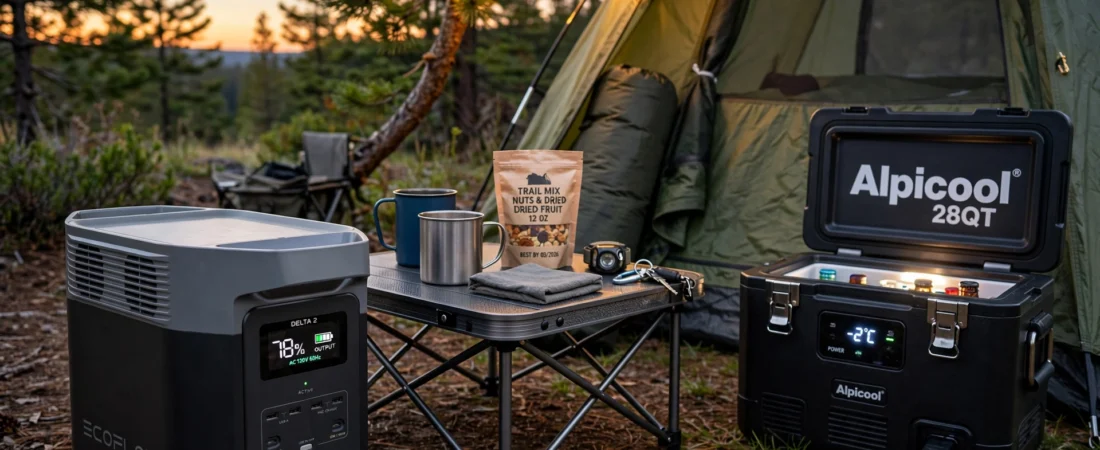
Camping power needs are different from home backup needs — you’re prioritizing weight, solar compatibility, and simplicity over raw capacity. A power station built for whole-home backup will just weigh you down at a campsite. Here’s how to pick the right unit for camping specifically, and our top picks across budget levels.
Quick Answer: Our Top Camping Picks
| Power Station | Best For | Capacity | Weight | Approx. Price |
|---|---|---|---|---|
| Jackery Explorer 1000 v2 | Best all-around camping pick | ~1,070Wh | ~23.8 lbs | $700–$800 |
| Jackery Explorer 300D | Ultralight / minimalist camping | ~292Wh | ~7.5 lbs | $250–$300 |
| Anker SOLIX C1000 Gen 2 | Fast recharge between trips | ~1,024Wh | ~26 lbs | $450–$500 |
| Bluetti Elite 30 V2 | Budget-friendly weekend trips | ~288Wh | ~9.4 lbs | $250–$280 |
| Jackery Explorer 2000 v2 | Extended, multi-day trips | ~2,042Wh | ~43 lbs | $700–$900 |
What Matters Most for Camping (Different from Home Backup)
Weight Matters More Than Capacity
Unlike home backup, where the unit sits in a garage or closet, a camping power station gets carried — from the car to the tent site, in and out of storage, sometimes over uneven terrain. A unit that’s 10 pounds heavier “for more capacity” often isn’t worth it if it turns setup into a chore every single trip. For most weekend camping needs, 300–1,000Wh is genuinely sufficient — resist the urge to over-buy capacity you’ll rarely use.
Solar Compatibility Is a Real Differentiator
If you’re camping away from outlets for more than a day or two, solar recharge capability becomes far more important than it is for home backup use (where you’ll typically just plug into the wall). Look specifically at maximum solar input wattage and whether the brand offers a well-matched, foldable solar panel — Jackery’s SolarSaga panels remain the most mature, purpose-built option for this exact use case.
Noise and Fan Behavior
Some power stations run their cooling fans audibly under load, which matters more at a quiet campsite than it does in a garage. If silent operation at your campsite matters to you (especially for overnight CPAP use), check independent reviews specifically mentioning fan noise under load, not just the spec sheet.
Durability and Weather Resistance
Camping units get exposed to dust, moisture, and temperature swings in ways home-backup units rarely do. Look for units with at least basic water/dust resistance ratings (IP54 or similar) if you plan to use yours outdoors regularly, particularly with the RIVER-style compact units designed specifically for this kind of exposure.
Top Picks Explained
Best All-Around: Jackery Explorer 1000 v2
For most campers, this remains the sweet spot. At roughly 1,070Wh with a 1,500W continuous output, it comfortably handles lights, an electric cooler, device charging, and even a coffee maker for a quick morning brew, all while staying light enough (about 23.8 lbs) to carry from car to campsite without much complaint. Pair it with a Jackery SolarSaga panel for multi-day trips away from power.
Why campers choose it: Best balance of capacity, weight, and Jackery’s proven solar ecosystem.
Best Ultralight Pick: Jackery Explorer 300D
If you’re backpacking, kayak camping, or simply want the lightest possible option for phone charging, LED lighting, and a CPAP machine, the Explorer 300 is hard to beat at roughly 7.5 lbs. It won’t run a cooler or coffee maker, but for minimalist trips where every pound matters, it’s the clear choice in this weight class.
Why campers choose it: Genuinely pocketable weight without sacrificing LiFePO4 battery chemistry.
Best for Fast Recharge Between Trips: Anker SOLIX C1000 Gen 2
If you camp frequently and don’t always have days of downtime between trips to recharge, the C1000 Gen 2’s rapid AC charging (roughly 58 minutes to full) means you can top off the night before a spontaneous weekend trip rather than planning days ahead. Its 1,800W continuous output also gives more headroom for running a small appliance than comparable Jackery units at this capacity.
Why campers choose it: You’ll never be caught with an undercharged unit before a last-minute trip.
Best Budget Pick: Bluetti Elite 30 V2
For casual campers who mainly need to keep phones and small lights running through a weekend, the Elite 30 V2 delivers real LiFePO4 performance and surprisingly fast AC charging (around 45 minutes to 80%) at one of the lowest price points in this category. It’s not built for appliances, but it comfortably covers essential camping device charging.
Why campers choose it: Real LiFePO4 battery chemistry without the premium price tag.
Best for Extended, Multi-Day Trips: Jackery Explorer 2000 v2
For extended off-grid trips — a week at a remote site, van life stints, or group camping where you’re running a cooler, lights, and multiple devices continuously — the Explorer 2000 v2’s roughly doubled capacity provides real breathing room. It’s noticeably heavier (around 43 lbs), so it’s best suited to car camping rather than anywhere you’ll be carrying it far on foot.
Why campers choose it: Enough capacity to comfortably go several days without recharging, especially paired with solar panels.
How Much Capacity Do You Actually Need for Camping?
| Trip type | Recommended capacity |
|---|---|
| Day trip / tailgating | 150–300Wh |
| Weekend trip (2–3 nights), lights + device charging | 300–600Wh |
| Weekend trip with electric cooler or CPAP | 600–1,000Wh |
| Extended trip (4+ nights) or group camping | 1,000–2,000Wh |
| Off-grid basecamp / van life | 2,000Wh+ with solar panels |
For a deeper breakdown of matching wattage to specific devices, see our full guide on how many watts you need in a power station.
Solar Panel Pairing Tips for Camping
If your trips regularly extend beyond a day or two, pairing your power station with a foldable solar panel is genuinely worth the extra cost. As a rough rule of thumb, aim for a solar panel wattage that’s at least 20-30% of your power station’s capacity in watt-hours for a reasonable full-day recharge in good sun — for example, a 100-200W panel pairs well with a 1,000Wh-class unit. See our full guide on charging a power station with solar panels for setup details.
Frequently Asked Questions
Is a bigger power station always better for camping? No — for most weekend trips, a 300-1,000Wh unit is genuinely sufficient, and the extra weight of a larger unit often isn’t worth carrying for capacity you won’t use. Match capacity to your actual trip length and devices, not the biggest number on the shelf.
Can I run an electric cooler off a camping power station? Yes, most 300Wh+ units can run a typical electric cooler (40-60W) for a full day or more per charge, making this one of the most popular camping use cases for portable power stations.
Do I need a solar panel, or is a fully charged unit enough for a weekend trip? For a standard 2-3 night weekend trip, a fully charged unit is usually enough without solar. Solar panels become worthwhile once trips extend beyond 2-3 days or when camping regularly without access to outlets in between.
What’s the quietest power station for camping near a tent? Fan noise varies significantly by model and load level; check recent, dated reviews that specifically mention fan behavior under load rather than relying on spec sheets alone, since manufacturers rarely publish decibel ratings for real-world use.
Final Verdict
For the vast majority of campers, the Jackery Explorer 1000 v2 remains the easiest recommendation — enough capacity for a comfortable weekend or extended trip, light enough to actually enjoy carrying, and backed by the most mature solar ecosystem in the category. Going lighter (Explorer 300) or bigger (Explorer 2000 v2) makes sense once you know your specific trip style, but the 1000v2 is where we’d tell a friend to start.
Curious how these camping picks compare to our overall rankings? Check out our complete guide to the best portable power stations for the full breakdown across every use case.
Prices and specifications are approximate and subject to change — always verify current pricing and specs directly with the manufacturer before purchasing.
Affiliate Disclosure: This post contains affiliate links. If you purchase through one of these links, we may earn a small commission at no extra cost to you. We only recommend products we believe genuinely deliver value to readers.