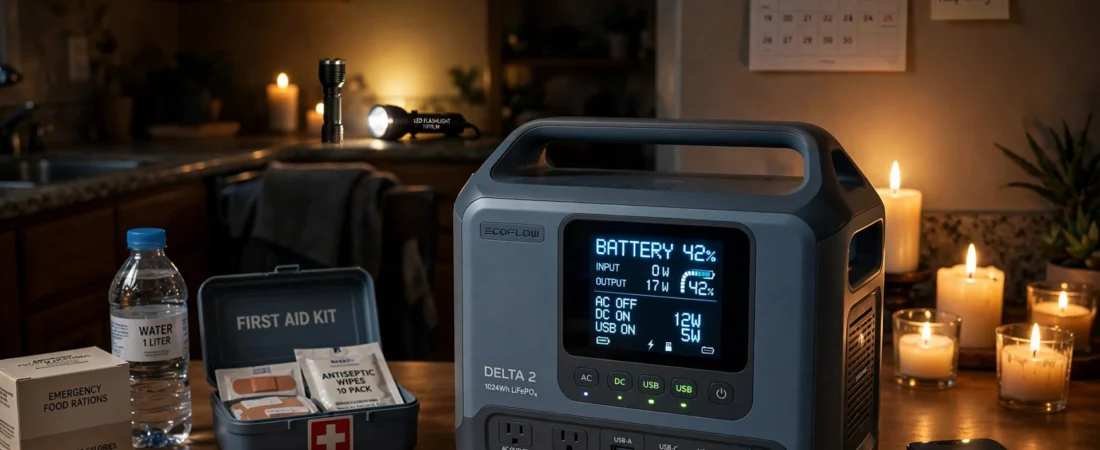
Home backup is arguably the most consequential use case for a solar generator — when the power goes out, you want a unit that will actually keep your essentials running, not one that sounded impressive on a spec sheet but falls short in practice. This guide covers what to prioritize specifically for home outage backup, and our top picks by household size and budget.
Quick Answer: Our Top Home Backup Picks
| Power Station | Best For | Capacity | Continuous Output | Approx. Price |
|---|---|---|---|---|
| Anker SOLIX C1000 Gen 2 | Essential circuits, small household | ~1,024Wh | 1,800W | $500–$550 |
| Bluetti AC180 | Best value for mid-size backup | ~1,152Wh | 1,800W | $450–$500 |
| EcoFlow DELTA 3 Plus | Fastest recharge during rolling outages | ~1,024–1,200Wh | 1,800W | $600–$700 |
| EcoFlow DELTA 3 MAX Plus | Whole-home partial backup | ~4,096Wh (expandable) | High continuous output | $2,500–$3,200 |
| Bluetti Elite 30 V2 | Small apartment / essentials-only | ~288Wh | 600W | $250–$280 |
What Matters Most for Home Outage Backup
Recharge Speed During Multi-Day Outages
This is the single most underrated spec for home backup use. During extended outages — hurricanes, winter storms, grid instability — power sometimes returns briefly before failing again. A unit that recharges to 80% in under an hour can catch that brief restoration window; a unit that takes 3-4 hours often won’t. This is why fast-charging brands like EcoFlow, Anker SOLIX, and Bluetti’s newer models have become especially popular specifically for outage preparedness.
UPS / Seamless Switchover for Sensitive Electronics
If you’re planning to keep a WiFi router, home computer, or medical equipment running, look specifically for a unit with UPS (uninterruptible power supply) functionality — this allows near-instantaneous switchover to battery power the moment grid power drops, avoiding the reboot or data-loss issues a several-second gap can cause on sensitive electronics.
Realistic Capacity Planning for Your Household
It’s easy to either drastically over-buy or under-buy capacity for home backup. Start by listing your genuinely essential circuits (refrigerator, WiFi, some lighting, phone charging, and any medical equipment) rather than assuming you need to power your entire home — see our full guide on how many watts you need for a detailed calculation method.
Indoor Safety
Unlike gas generators, solar generators produce no carbon monoxide and are safe to run indoors, which matters significantly for home backup use, especially during winter storms when running anything outdoors isn’t practical. This is one of the clearest safety advantages of choosing a solar/battery generator over a traditional fuel generator for home use.
Expandability if Your Needs Might Grow
If there’s a reasonable chance you’ll want to expand your backup capacity over time — adding circuits, preparing for longer outages, or eventually moving toward whole-home coverage — starting with an expandable-ecosystem brand (EcoFlow DELTA series, Anker SOLIX, Bluetti AC-series) avoids having to replace your entire system down the line.
Top Picks Explained
Best for Essential Circuits, Small Household: Anker SOLIX C1000 Gen 2
For a typical small household wanting to keep a refrigerator, WiFi, some lighting, and device charging running through an overnight-to-full-day outage, the C1000 Gen 2 offers a strong combination of capacity, fast recharge (around 58 minutes), and UPS-style switchover — all at a genuinely accessible price point.
Why homeowners choose it: Excellent balance of price, speed, and essential-circuit capability for most households’ realistic outage needs.
Best Value for Mid-Size Backup: Bluetti AC180
At around $499 with 1,152Wh capacity and 1,800W output, the AC180 delivers some of the strongest price-per-watt-hour in this category, with a 45-minute recharge to 80% that puts it in the same performance class as pricier competitors. For households wanting solid mid-size backup without paying a brand premium, this is a standout value.
Why homeowners choose it: Comparable performance to pricier competitors at a meaningfully lower price.
Best for Rolling/Multi-Day Outages: EcoFlow DELTA 3 Plus
For homeowners in areas prone to extended or rolling outages (hurricane zones, areas with aging grid infrastructure), the DELTA 3 Plus’s roughly 43-minute recharge to 80% via X-Stream charging is specifically valuable for catching brief grid-restoration windows before the next outage hits.
Why homeowners choose it: Among the fastest recharge times available, directly addressing the most common failure mode during extended outages.
Best for Whole-Home Partial Backup: EcoFlow DELTA Pro 3
For homeowners wanting to keep significantly more than just the essentials running — potentially including partial HVAC support, well pumps, or multiple major appliances — the DELTA Pro 3’s much larger base capacity and expandability, combined with the option to integrate with a home transfer panel, moves it into genuine whole-home backup territory rather than essentials-only coverage.
Why homeowners choose it: A realistic path toward comprehensive home backup rather than just a few circuits.
Best for Apartments / Essentials-Only: Bluetti Elite 30 V2
For apartment dwellers or anyone with more limited backup needs (phones, a WiFi router, some lighting, and possibly a CPAP machine), the compact, affordable Elite 30 V2 with its 10ms UPS switchover covers the essentials without the cost or bulk of a larger system.
Why homeowners choose it: Genuine UPS functionality and LiFePO4 reliability at an entry-level price and footprint.
Realistic Runtime Expectations During an Outage
| Household setup | Approx. capacity needed | Realistic runtime on essentials |
|---|---|---|
| Apartment: WiFi, lights, phone charging | 300–600Wh | 12–24+ hours |
| Small home: add refrigerator | 1,000Wh | 12–20 hours (fridge cycles intermittently) |
| Medium home: fridge + more lighting + medical equipment | 1,500–2,000Wh | 20–30+ hours |
| Larger home: partial HVAC, well pump, multiple major appliances | 3,000Wh+, expandable | Multi-day with careful management, longer with solar |
For extended multi-day outages, pairing your unit with solar panels for daytime recharging significantly extends how long you can sustain essential circuits — see our guide on charging with solar panels for setup guidance.
Frequently Asked Questions
How many portable power stations do I need for whole-home backup? For genuine whole-home coverage (not just essential circuits), most households need either a single large expandable system (like the EcoFlow DELTA Pro 3 with add-on batteries) or would be better served by a professionally installed standby home generator system. Portable units in the 1,000-2,000Wh range are best suited to essential-circuit backup, not full-home coverage.
Can I run my furnace or central AC off a home backup power station? Only with high-capacity, high-output units, and typically only briefly given how much power heating and cooling systems draw on startup and during operation. Most portable power stations are better suited to lighting, refrigeration, medical equipment, and electronics rather than HVAC systems, unless you’ve specifically invested in a whole-home-capable expandable system.
Is it safe to run a power station indoors during a storm? Yes — unlike gas generators, portable power stations produce no exhaust fumes or carbon monoxide, making them safe for indoor use, which is one of their key advantages for home backup specifically during weather events when outdoor generator use isn’t practical or safe.
How often should I charge my power station if I’m keeping it for emergencies only? Most manufacturers recommend recharging every 3 months even if the unit isn’t used, since lithium batteries slowly self-discharge over time. See our guide on battery lifespan and storage for detailed maintenance recommendations.
Final Verdict
For most households, the Anker SOLIX C1000 Gen 2 or Bluetti AC180 offer the strongest combination of price, capacity, and fast recharge for realistic essential-circuit backup. Households wanting more comprehensive coverage — or living in areas with frequent, extended outages — should look toward the EcoFlow DELTA Pro 3 for genuine whole-home partial backup capability.
Want to see how these home backup picks compare across every use case? Check out our complete guide to the best portable power stations for the full breakdown.
Prices and specifications are approximate and subject to change — always verify current pricing and specs directly with the manufacturer before purchasing. For serious whole-home backup needs, also consult a licensed electrician about professionally installed standby generator options.
Affiliate Disclosure: This post contains affiliate links. If you purchase through one of these links, we may earn a small commission at no extra cost to you. We only recommend products we believe genuinely deliver value to readers.