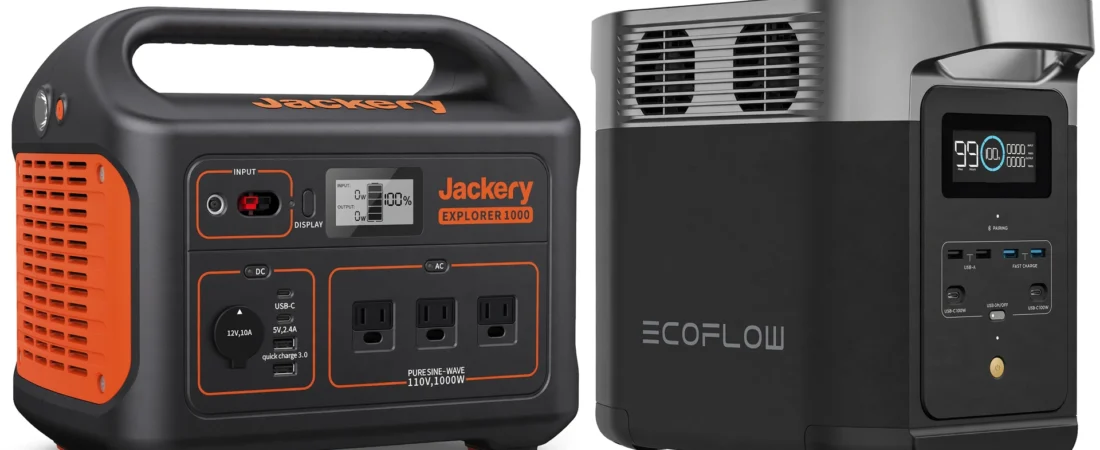
Jackery and EcoFlow are the two most recognized names in portable power stations, and if your shortlist has narrowed down to these two brands, you’re in good company — most buyers end up comparing exactly these two before deciding. Both make reliable, well-reviewed products, but they take genuinely different approaches to charging speed, battery chemistry, and overall philosophy. Here’s how they actually compare, model by model and category by category.
Quick Answer
Choose EcoFlow if you want the fastest possible AC charging speed, an expandable ecosystem for home backup, and the most polished companion app on the market. Choose Jackery if you prioritize lightweight portability, a longer charge-cycle lifespan, and one of the most reliable solar panel ecosystems available for off-grid charging.
Neither brand is objectively “better” across the board — the right choice depends heavily on how you plan to use the unit.
Brand Overview
Jackery, founded in 2012, is widely credited with popularizing the portable power station category and has sold millions of units globally. Its Explorer line is built around simplicity, durability, and a lightweight design, backed by over a decade of field use and one of the most mature solar panel ecosystems (SolarSaga) in the industry.
EcoFlow, founded in 2017, made its biggest impact with the DELTA series, introducing fast AC charging technology (X-Stream) and, later, modular expandable capacity with the DELTA Pro line. EcoFlow has built out the most developed smart-home ecosystem of any major brand, with an app that offers real-time power monitoring, remote control, and scheduling.
Head-to-Head: 1,000Wh Class (Most Popular Tier)
| Spec | Jackery Explorer 1000 v2 | EcoFlow DELTA 3 Plus |
|---|---|---|
| Capacity | ~1,070Wh | ~1,024–1,200Wh (model dependent) |
| Battery chemistry | LiFePO4 | LiFePO4 |
| Continuous AC output | 1,500W | 1,800W |
| AC charge time (0–80%) | ~70 minutes | ~43 minutes |
| Weight | ~23.8 lbs | ~28.6 lbs |
| Charge cycles (rated) | 4,000+ | 3,000+ |
| Expandable | No | Limited, model dependent |
At this capacity tier, EcoFlow’s charging speed advantage is the standout difference — its X-Stream technology can take the DELTA 3 Plus from empty to 80% in well under an hour, while the Jackery equivalent typically needs over an hour for the same charge level. If you frequently need to top off quickly between uses, this is a meaningful practical advantage.
Jackery counters with a lighter unit (helpful for anyone who regularly carries the power station any distance) and a higher rated cycle life, meaning the battery is engineered to remain usable for more total charge-and-discharge cycles over its lifetime.
Head-to-Head: 2,000Wh+ Class (Home Backup / Extended Use)
| Spec | Jackery Explorer 2000 Plus | EcoFlow DELTA Pro 3 |
|---|---|---|
| Base capacity | ~2,042Wh | ~4,096Wh |
| Expandable to | ~12kWh with add-on packs | ~25kWh with add-on packs |
| Continuous AC output | Varies by configuration | Higher continuous output, supports demanding loads |
| Best suited for | Off-grid camping, van life, moderate home backup | Serious whole-home backup, 240V-capable configurations available |
At the higher capacity tier, EcoFlow pulls further ahead for anyone whose primary goal is whole-home backup. The DELTA Pro ecosystem starts with a larger base capacity, expands further, and offers a more mature path toward integrating with a home’s electrical panel via a transfer switch. Jackery remains a strong, more portable option at this tier if your priority is still travel and off-grid use rather than powering an entire house.
Battery Chemistry: Both Brands Have Moved to LiFePO4
This is one area where the gap between the two brands has narrowed significantly. EcoFlow shifted the vast majority of its lineup to LiFePO4 (lithium iron phosphate) batteries early, while Jackery’s newer “Plus” and “Pro” model lines have caught up, also using LiFePO4. The main caveat: some of Jackery’s older, legacy Explorer models still use standard lithium-ion (NMC) chemistry with a shorter cycle life, so it’s worth double-checking the specific model you’re considering rather than assuming based on brand alone.
Charging Speed: EcoFlow’s Clearest Advantage
EcoFlow’s proprietary X-Stream charging technology is consistently the fastest in its class, often reaching 80% charge from a standard wall outlet in under an hour across most of its current lineup. Jackery has improved its charging speeds considerably with newer “Plus” models featuring faster charge modes, but still generally trails EcoFlow by a meaningful margin on raw AC recharge time.
This matters most in two scenarios: during multi-day power outages where the grid occasionally comes back online for short windows (a fast-charging unit can top off before the next outage hits), and for anyone who tends to forget to charge before a trip and needs to top off quickly.
Solar Ecosystem: Jackery’s Strongest Category
Jackery’s SolarSaga solar panels are widely regarded as some of the most reliable and well-built portable panels on the market, with a mature bundle system that pairs cleanly with each Explorer model. For buyers planning to rely heavily on solar charging — off-grid cabins, extended van life, remote camping — Jackery’s solar ecosystem generally feels more polished and purpose-built than EcoFlow’s, even though EcoFlow’s panels are also capable performers.
App and Smart Features: EcoFlow’s Strongest Category
EcoFlow’s companion app is consistently rated as more advanced than Jackery’s, offering real-time power flow visualization, remote monitoring, charge scheduling, and smart home integrations. If monitoring and controlling your power usage remotely matters to you — for example, checking your home backup system’s status while away — EcoFlow currently offers the more complete experience.
Weight and Portability: Jackery’s Advantage
Across comparable capacity tiers, Jackery units tend to run noticeably lighter than their EcoFlow counterparts — often several pounds lighter in the popular 1,000Wh class. For backpackers, car campers carrying gear over distance, or anyone who prioritizes a lighter load, this difference adds up over repeated use.
Price Comparison
Pricing between the two brands is broadly competitive at equivalent capacity tiers, with frequent sales and promotions (especially around Black Friday and Prime Day) significantly affecting real-world prices. Rather than comparing list prices, it’s more useful to compare price-per-watt-hour at the time of purchase, since discounts can shift the value equation considerably from month to month.
Which Brand Should You Choose?
Choose Jackery if:
- You prioritize lightweight, portable units for camping, van life, or travel
- You want a mature, reliable solar panel ecosystem for off-grid charging
- Longer rated cycle life matters more to you than the fastest possible charging speed
- You value over a decade of field-tested reliability and a broad product range
Choose EcoFlow if:
- Fast AC charging speed is a priority (multi-day outages, frequent quick top-offs)
- You want the most advanced app experience with remote monitoring and control
- You’re planning toward whole-home backup and want a more mature expandable ecosystem
- You need higher continuous output to run demanding appliances
Frequently Asked Questions
Is EcoFlow more expensive than Jackery? Not consistently — pricing varies significantly by specific model and ongoing promotions. It’s worth comparing price-per-watt-hour on the exact models you’re considering rather than assuming either brand is categorically more expensive.
Which brand is better for RV use? EcoFlow’s higher continuous output and faster charging tend to make it a stronger fit for RV use, where you may need to run higher-draw appliances and want to top off quickly during short stops. Jackery remains a solid choice for lighter RV setups prioritizing weight savings.
Which brand has better customer support? Both brands offer standard warranty coverage and responsive customer support, though experiences can vary. It’s worth checking recent, dated reviews before purchasing, since support quality can shift over time as companies scale.
Can I mix Jackery and EcoFlow accessories? No — solar panels, expansion batteries, and most accessories are proprietary to each brand’s connector and voltage specifications. Plan to stay within one brand’s ecosystem when building out solar panels or expansion capacity.
Final Verdict
For most buyers prioritizing everyday portability, off-grid solar charging, and long-term battery life, Jackery remains an excellent, well-proven choice. For buyers who prioritize charging speed, smart home integration, and a clear path toward whole-home backup, EcoFlow currently has the edge. Both brands make genuinely reliable LiFePO4-based products in 2026 — the right pick comes down to which specific strengths matter most for your use case.
Want to see how these models compare to other major brands? Check out our complete guide to the best portable power stations for the full rankings across every brand and price point.
Specifications and pricing are approximate and based on publicly available manufacturer data and independent testing as of 2026. Always verify current specs and pricing directly with the manufacturer before purchasing, as both brands update their lineups frequently.