
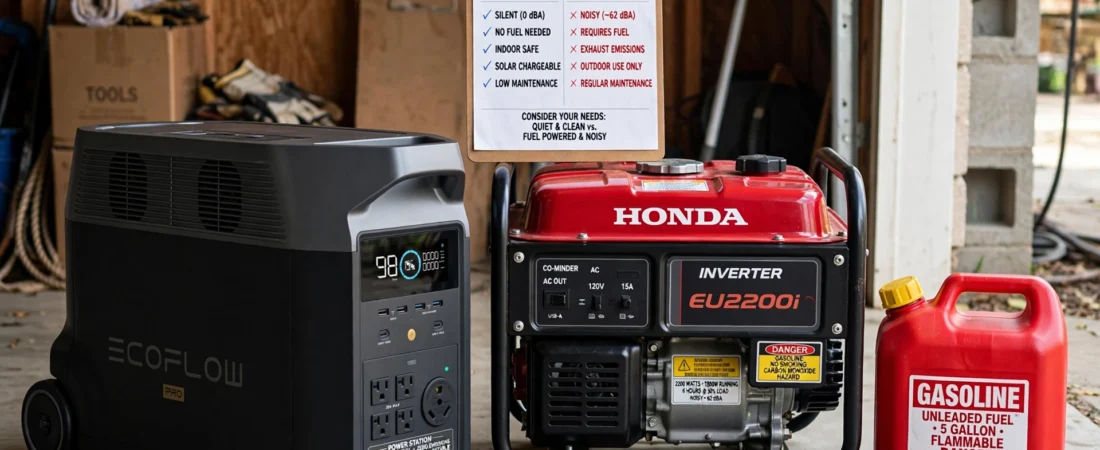
Solar generators have gone from a niche prepper purchase to a mainstream household item over the past few years — but at $300 to $3,000+ depending on capacity, it’s a legitimate question to ask before buying: is it actually worth the money, or is this a purchase you’ll regret leaving in the closet? Here’s an honest breakdown of the real pros and cons.
The Short Answer
For most homeowners, renters, campers, and RV owners, a solar generator is worth it — but the “worth it” calculation depends heavily on why you’re buying one and how often you’ll realistically use it. It’s a poor fit if you’re buying purely out of anxiety and will never test or use the unit; it’s an excellent fit if you have a concrete, recurring use case (regular power outages, camping trips, RV travel, or medical equipment that needs backup power).
The Case For: Why a Solar Generator Is Worth It
1. Silent, Fume-Free Backup Power
Unlike gas generators, solar generators produce zero emissions and run silently, making them safe to use indoors and considerate to neighbors. If you live somewhere with frequent outages — hurricane-prone areas, regions with an aging power grid, or winter-storm-heavy climates — this alone can justify the purchase for peace of mind and genuine safety (no carbon monoxide risk).
2. Zero Ongoing Fuel Costs
Once purchased, a solar generator has no recurring fuel expenses. You’re not buying, storing, or stabilizing gasoline, and you’re not paying for propane refills. Over several years of occasional use, this can meaningfully offset the higher upfront cost compared to a gas generator.
3. Multi-Purpose Utility
A solar generator isn’t just an emergency-only purchase — the same unit that backs up your fridge during an outage can power a camping trip, a tailgate, a backyard movie night, or a work site with no outlet access. This dual-purpose utility is a major factor in whether the investment feels worthwhile.
4. Medical Equipment Reliability
For anyone dependent on a CPAP machine, home oxygen concentrator, or other medical device, a solar generator can provide genuine peace of mind and real safety value during outages — a use case where the cost is easy to justify regardless of how often it’s actually needed.
5. Minimal Maintenance
There’s no oil to change, no engine to service, and no fuel to rotate out before it goes stale. Beyond basic storage care (discussed in our guide on battery lifespan), a solar generator is largely maintenance-free.
The Case Against: When It’s Not Worth It
1. High Upfront Cost for Occasional Use
If you live somewhere with reliable grid power and don’t camp, RV, or spend time off-grid, a solar generator can become an expensive item that sits unused in a closet. A $600-$1,500 purchase that gets used once every few years has a very different value proposition than one used weekly.
2. Limited Power for Whole-Home Backup
Entry and mid-level solar generators (under 2,000Wh) are not designed to replace a whole-home backup generator. If your primary goal is running central AC, well pumps, or your entire home’s electrical panel during multi-day outages, a solar generator (at least at accessible price points) will likely disappoint you relative to a professionally installed standby generator — though this is changing as expandable, home-integrated systems become more available.
3. Weather-Dependent Recharging
If you’re relying on solar panels as your only recharge method during an extended outage, cloudy weather will meaningfully slow down your ability to recharge. This is a real limitation worth planning around — most owners also keep the option to recharge via a car or generator as backup.
4. Depreciating Technology
Battery and inverter technology in this space is improving quickly. A model that feels cutting-edge today may be meaningfully outperformed (in charging speed, weight, or capacity) within 2-3 years by newer releases at similar prices. This isn’t a reason to avoid buying, but it’s worth choosing a well-established brand with strong resale value if this concerns you.
A Practical Framework: Should You Buy One?
Ask yourself these questions:
Do you experience power outages more than once or twice a year? If yes, the case for owning a solar generator strengthens significantly — even a mid-size unit pays for itself in convenience and safety over a few uses.
Do you camp, RV, or spend time off-grid at least a few times a year? If yes, a solar generator effectively serves double duty, making the cost easier to justify since it’s not a single-purpose emergency item.
Do you or a family member rely on medical equipment that requires reliable power? If yes, this alone is often reason enough to prioritize the purchase, regardless of how frequently outages occur in your area.
Is your primary goal running your entire home (including AC, heating, or well pump) during multi-day outages? If yes, be realistic about your budget — you’ll likely need a large, expandable system (or ultimately a whole-home standby generator), not an entry-level portable unit.
Cost Comparison: Solar Generator vs. Gas Generator Over Time
| Solar Generator | Gas Generator | |
|---|---|---|
| Upfront cost (mid-size) | $600–$1,500 | $500–$1,200 |
| Annual fuel cost | $0 | $100–$300+ (fuel, stabilizer) |
| Maintenance cost (5 years) | Near $0 | $200–$500 (oil changes, tune-ups) |
| Indoor use | Yes | No — carbon monoxide risk |
| Noise | Silent | 60–90 decibels |
| 5-year estimated total cost | $600–$1,500 | $1,200–$2,700+ |
While the upfront cost of a solar generator can be higher, the absence of ongoing fuel and maintenance costs often makes it the more economical choice over a multi-year period, in addition to the safety and convenience benefits.
Frequently Asked Questions
Is a solar generator a good investment, or just peace of mind? Both, depending on your use case. For frequent campers or RV owners, it’s a practical, regularly-used tool. For emergency-only buyers, it functions more like insurance — you’re paying for the option to have reliable power when you need it, which has real value even if it’s used infrequently.
How much should I spend on my first solar generator? For most first-time buyers, a 1,000Wh-class unit ($400-$800) offers the best balance of usefulness and cost. See our guide on what you can run with a 1,000Wh power station for specifics.
Will a solar generator pay for itself? In direct financial terms compared to grid electricity, no — solar generators are not typically about saving money on your electric bill. The value comes from backup reliability, avoided generator fuel costs over time, and multi-purpose use (camping, RV, work sites) rather than bill savings.
Is it worth buying now, or should I wait for newer technology? Battery and inverter technology continues to improve, but waiting indefinitely means going without backup power in the meantime. If you have a genuine, current need (upcoming storm season, planned camping trips), buying a well-reviewed current-generation model is generally a better choice than waiting for hypothetical future improvements.
Final Verdict
A solar generator is worth it for the large majority of buyers who have at least one concrete use case — regular outages, camping, RV travel, or medical equipment reliance — rather than buying purely out of general anxiety about “what if.” The combination of zero fuel costs, silent and safe indoor operation, and multi-purpose utility makes it a genuinely practical purchase for most households, as long as you size the unit realistically to your actual needs rather than assuming bigger is always better.
Ready to find the right model for your budget and use case? Check out our complete guide to the best portable power stations to compare our top picks across every price range.
Cost comparisons are approximate and will vary based on regional fuel prices, specific models, and usage patterns.