The 1,000Wh capacity class has become the most popular category of portable power station, and for good reason — it hits a sweet spot between price, portability, and real-world usefulness. But “1,000 watt-hours” doesn’t mean much until you translate it into actual hours of actual devices. This guide breaks down exactly what you can expect to run, and for how long.
Quick Reference: Runtime Estimates for a 1,000Wh Power Station
| Device | Typical Wattage | Approx. Runtime on 1,000Wh |
|---|---|---|
| Smartphone (charging) | 10W | ~85 charges |
| Laptop | 60W | ~14 hours |
| WiFi router | 15W | ~55 hours |
| LED light bulb | 10W | ~85 hours |
| CPAP machine (no humidifier) | 40W | ~21 hours |
| Mini fridge | 70W (cycling) | ~12–14 hours |
| Full-size refrigerator | 150W (cycling) | ~6–7 hours |
| Box fan | 60W | ~14 hours |
| Electric cooler | 50W | ~17 hours |
| Coffee maker | 1,000W | ~50 minutes |
| Microwave | 900W | ~55 minutes |
| Space heater | 1,200W | ~40 minutes |
| Window AC unit | 900W | ~55 minutes |
Note: these figures assume roughly 85–90% inverter efficiency and do not account for appliances that cycle on and off (like refrigerators), which often extend real-world runtime beyond continuous-use estimates. Actual results will vary by brand, ambient temperature, and battery age.
Realistic Scenarios: What 1,000Wh Actually Looks Like in Practice
Numbers on a spec sheet are one thing — actually picturing a day with your power station is more useful. Here are three common real-world scenarios.
Scenario 1: Power Outage at Home
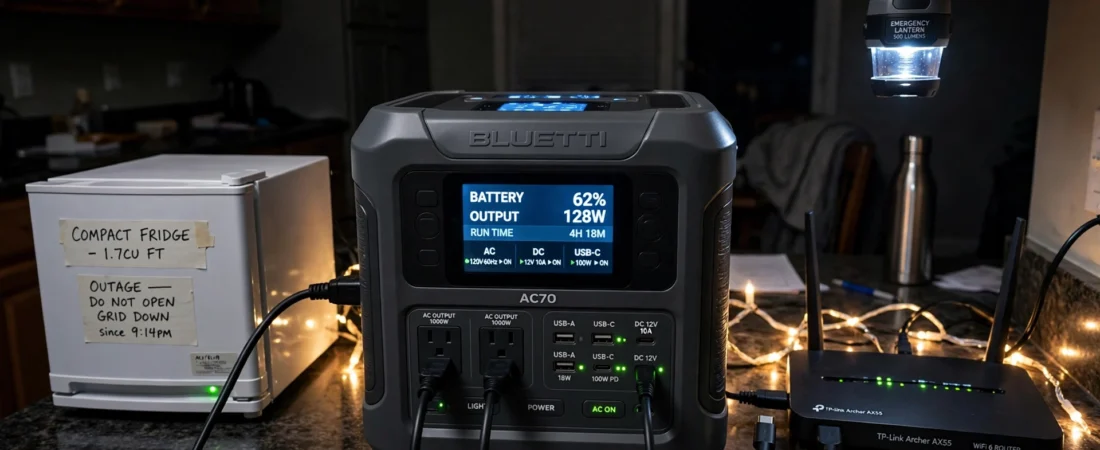
Imagine your power goes out overnight. You want to keep the essentials running: a refrigerator, a few lights, your WiFi router, and phone charging.
- Refrigerator (cycling): ~150W average → roughly 6–7 hours if run continuously, but refrigerators typically only run their compressor about 30–40% of the time, so realistic runtime is often closer to 15–20 hours before the battery is depleted.
- 3 LED lights: 30W combined
- WiFi router: 15W
- Phone charging twice: negligible draw
Bottom line: A single 1,000Wh power station can realistically keep your essential devices running through an overnight-to-full-day outage, especially if you’re mindful about not running high-draw appliances like a microwave or space heater at the same time.
Scenario 2: Weekend Camping Trip
Imagine a two-night camping trip where you want lights, phone charging, a fan, and an electric cooler running most of the time.
- Electric cooler: 50W average → runs most of a full day per charge
- LED camp lights: 20W combined
- Fan (evening use): 60W for a few hours
- Phone and device charging: minimal draw
Bottom line: A 1,000Wh unit comfortably covers a weekend trip’s worth of lighting, device charging, and a cooler, especially if you’re able to top it off with a solar panel during the day.
Scenario 3: CPAP Machine for Multiple Nights
Many buyers specifically look at 1,000Wh units to keep a CPAP machine running during travel or power outages.
- CPAP machine (no heated humidifier): ~40W → roughly 21 hours of runtime, or about 2–3 full nights of use
- CPAP machine (with heated humidifier): ~60–80W → closer to 12–16 hours, or 1–2 nights
Bottom line: A 1,000Wh power station can reliably get you through several nights of CPAP use without humidifier, or one to two nights with the humidifier running, making it a popular “peace of mind” purchase for travelers and frequent outage areas.
What You Should NOT Expect from a 1,000Wh Unit
To set realistic expectations, here’s what a 1,000Wh power station typically cannot sustain for long:
- Whole-home backup — it can carry essential circuits for a matter of hours, not your entire house for days.
- Continuous space heater or AC use — these high-draw appliances will drain a 1,000Wh battery in under an hour of continuous use.
- Multiple high-wattage appliances simultaneously — running a microwave and a coffee maker at the same time, for example, will likely exceed most 1,000Wh-class units’ peak output rating, not just drain the battery quickly.
If your needs include any of the above on a regular basis, it’s worth considering a 2,000Wh+ expandable model instead.
How to Extend Your Runtime
A few practical habits can meaningfully stretch how long a 1,000Wh power station lasts:
- Add a solar panel. Even a single 100–200W panel can meaningfully offset your usage during daylight hours, especially for multi-day scenarios.
- Avoid running high-draw appliances back-to-back. Stagger use of anything over 500W rather than running them simultaneously.
- Use LED lighting instead of incandescent. LEDs use a fraction of the power for the same brightness.
- Unplug devices in standby mode. Chargers and adapters left plugged in but not actively charging still draw a small amount of “phantom” power over time.
Frequently Asked Questions
Is 1,000Wh enough for a power outage? For most households, yes — a 1,000Wh power station can comfortably cover essential devices (refrigerator, lights, WiFi, phone charging) for roughly 12–24 hours, depending on usage patterns. For outages lasting multiple days, consider a larger or expandable unit, or plan to recharge via solar or a car during the outage.
Can a 1,000Wh power station run a refrigerator all day? Yes, in most cases. Because refrigerator compressors cycle on and off rather than running continuously, a 1,000Wh unit typically provides 15–20+ hours of intermittent refrigerator operation, even though the continuous-use math suggests only 6–7 hours.
How many times can I charge my phone with a 1,000Wh power station? Roughly 80–90 full charges, accounting for typical charging efficiency losses, though this will vary slightly by phone model and battery size.
Can I run a microwave with a 1,000Wh power station? Briefly, yes — as long as the unit’s peak wattage output exceeds the microwave’s wattage draw (often 900–1,200W). However, you’ll only get roughly 45–60 minutes of total microwave use before the battery is depleted, so it’s best reserved for occasional, short use rather than regular cooking.
Final Thoughts
A 1,000Wh power station strikes a genuinely useful balance for most people: enough capacity to meaningfully cover a home power outage or a camping trip, without the price tag or weight of the larger 2,000Wh+ models built for whole-home backup. Just be realistic about what falls outside its comfort zone — high-draw appliances like space heaters, ACs, and microwaves will drain it quickly, so plan your usage accordingly.
Want to compare specific 1,000Wh-class models? Check out our complete guide to the best portable power stations to see our top picks in this capacity range.
Runtime estimates are approximate and based on typical appliance wattages and inverter efficiency. Actual performance varies by brand, battery age, and ambient temperature.