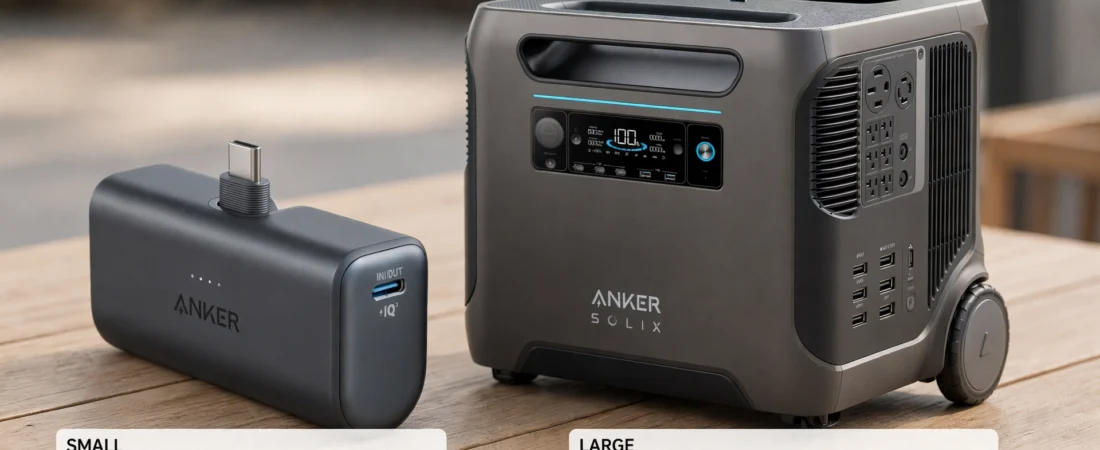
If you’ve been browsing for backup power options, you’ve probably noticed that “power bank” and “power station” get used almost interchangeably online — even though they’re very different products. Buying the wrong one for your needs is one of the most common (and expensive) mistakes first-time buyers make. This guide breaks down exactly what separates a portable power station from a battery bank, so you know which one actually fits your situation.
The Short Answer
A battery bank (also called a power bank) is a small, pocket-sized battery designed to recharge phones, tablets, and other USB devices a few times before needing to be recharged itself. A portable power station is a much larger, heavier unit with an inverter and AC outlets, designed to run full-size appliances like refrigerators, laptops, and power tools — not just top off a phone.
Think of it this way: a battery bank extends your phone’s battery life by a few hours. A power station can run your refrigerator for a full day.
Side-by-Side Comparison
| Battery Bank | Portable Power Station | |
|---|---|---|
| Typical capacity | 5,000–30,000mAh (roughly 18–108Wh) | 300–3,000+ Wh |
| Weight | 4–20 oz | 7–70+ lbs |
| Output type | USB / USB-C only | AC outlets, USB, DC, and often car outlets |
| Can run appliances? | No | Yes |
| Recharge time | 1–3 hours | 1–6 hours (varies widely) |
| Typical price | $20–$80 | $200–$3,000+ |
| Best for | Charging phones/tablets on the go | Home backup, camping, RVs, appliances |
Why the Confusion Happens
Both products are technically “portable batteries with a charging function,” which is why marketing language sometimes blurs the line. Some manufacturers even label mid-size units (200–300Wh) as “power banks” simply because they’re smaller than their flagship models, even though functionally they behave like small power stations because they include AC outlets. The clearest way to tell them apart isn’t the name on the box — it’s whether the unit has an AC outlet capable of powering standard appliances.
What Each One Is Actually Built For
Battery Banks: Built for Mobile Devices
Battery banks are measured in milliamp-hours (mAh), a unit designed around phone and tablet batteries. A typical smartphone battery holds somewhere around 3,000–5,000mAh, so a 20,000mAh battery bank can recharge a phone roughly 3–5 times before it needs recharging itself.
Battery banks are ideal for:
- Air travel and daily commuting
- Keeping a phone charged during a festival or hiking day trip
- Emergency phone charging during short power interruptions
They are not designed to run anything with a plug — no lamps, no fans, no laptops charging via a standard AC adapter (though some higher-end battery banks do include USB-C Power Delivery capable of charging laptops via USB-C).
Portable Power Stations: Built for Appliances
Power stations are measured in watt-hours (Wh), a unit that reflects total stored energy rather than a phone-specific metric. This is combined with a wattage rating (W) that tells you how much power the unit can output at once, and — critically — an inverter that converts stored battery power into standard AC household current.
Portable power stations are ideal for:
- Keeping a refrigerator running during a power outage
- Running a CPAP machine overnight while camping
- Powering lights, a mini fridge, and charging multiple devices at a campsite
- Running power tools at a job site with no outlet access
- Whole-home backup when paired with larger, expandable units
Can a Battery Bank Do What a Power Station Does?
Not really, and this is where buyers sometimes get burned. A battery bank simply doesn’t have the internal components (a full inverter, sufficient stored capacity, or AC output) to run appliances. Trying to use one for anything beyond charging small USB devices will either not work at all, or in the case of some higher-capacity banks with limited USB-C PD output, only work for very low-power devices like a laptop — never a refrigerator, fan, or lamp.
Can a Power Station Replace a Battery Bank?
Technically, yes — most power stations include USB ports and can absolutely charge your phone. But carrying a 15–30 lb power station in your bag just to charge your phone on your commute would be like driving a truck to pick up a single grocery bag. If your only need is keeping your phone charged on the go, a dedicated battery bank is lighter, cheaper, and far more practical.
Which One Do You Actually Need?
Ask yourself these two questions:
1. What do you need to power? If the answer is “just my phone and maybe a tablet,” a battery bank is all you need. If the answer includes anything with a plug — a fridge, a fan, a laptop charger, medical equipment, or power tools — you need a portable power station.
2. How long do you need it to last? Battery banks are built for a single day or a short trip. Power stations, especially when paired with solar panels, are built for multi-day use or ongoing backup during extended outages.
A Simple Rule of Thumb
- Daily commute, air travel, festivals → Battery bank
- Camping trip with lights, a cooler, and device charging → Small-to-mid power station (300–1,000Wh)
- Home backup during outages → Mid-to-large power station (1,000–3,000Wh+)
- RV, off-grid cabin, or job site power → Large, expandable power station (2,000Wh+)
Frequently Asked Questions
Can I use a battery bank to charge a power station? No — battery banks don’t have the voltage or capacity to meaningfully charge a power station. Power stations are recharged via wall outlets, car chargers, or solar panels, not smaller batteries.
Is a bigger battery bank the same as a small power station? Not necessarily. The deciding factor isn’t size or capacity alone — it’s whether the unit includes a true AC outlet and inverter. Always check the specification sheet for “AC output” before assuming a large battery bank can run appliances.
Do I need both a battery bank and a power station? Many people do. A battery bank is convenient for daily device charging without carrying around a heavy power station, while the power station stays reserved for emergencies, camping, or appliance use.
Final Thoughts
The names sound similar, but battery banks and portable power stations solve two completely different problems. If you’re shopping for emergency home backup, camping power, or anything involving appliances, you want a power station — not a battery bank, regardless of how high its mAh rating looks on the box.
Ready to compare specific models? Check out our complete guide to the best portable power stations to find the right capacity for your needs.
This article is for general educational purposes. Specifications vary by brand and model — always check the manufacturer’s listed AC output and capacity before purchasing.