If you’ve started shopping for backup power and keep seeing the term “solar generator,” you might be picturing something complicated — solar panels, complex wiring, maybe even needing an electrician.
The good news is that modern solar generators are designed to be about as complicated as plugging in a lamp. In this guide, we’ll break down exactly how they work, what’s actually happening inside the box, and why they’ve become such a popular alternative to traditional gas generators.
What Is a Solar Generator, Really?
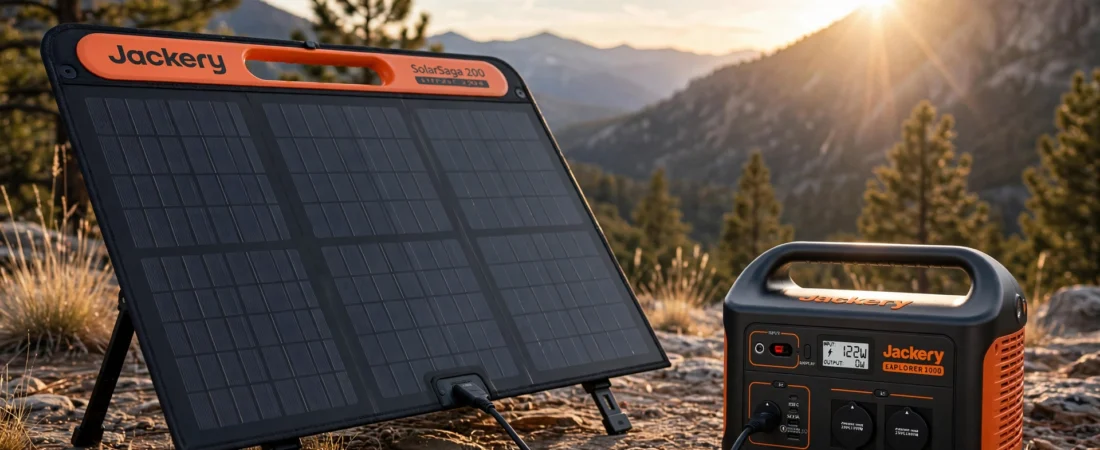
Despite the name, a solar generator doesn’t “generate” electricity from the sun the way a massive solar farm does. It is actually a combination of two separate components working together:
- A Portable Power Station: A large, high-capacity rechargeable battery equipped with an internal inverter and multiple outlets. Think of it as a giant, heavy-duty phone power bank.
- Solar Panels: The external component that physically collects and converts sunlight into usable electrical energy.
When people use the term “solar generator,” they usually mean the power station and the solar panel bundled together as a cohesive system. The power station stores the energy, while the solar panel feeds it. Neither part does much without the other, which is why most brands sell them together as a kit.
The Four-Step Process, Explained
Here is what actually happens, step by step, when a solar generator powers your electronics:
Step 1: Sunlight Hits the Solar Panel
Solar panels are made of photovoltaic (PV) cells — thin layers of silicon that react directly to sunlight. When photons (particles of light) strike these cells, they knock electrons loose, creating a flow of electricity. This is called the photovoltaic effect, and it is the same basic technology used in residential rooftop solar installations, just on a smaller, portable scale.
Step 2: Electricity Travels to the Power Station
The electricity generated by the panels is direct current (DC) — the exact same type of current stored inside batteries. This raw DC power travels through a heavy-duty cable from the solar panel directly into the input charging port of your power station.
Step 3: The Battery Stores the Energy
Inside the power station sits a high-grade rechargeable battery (almost always a LiFePO4 or lithium-ion battery in modern 2026 units). As DC electricity flows in, an internal Battery Management System (BMS) regulates the charging process. The BMS controls the voltage and current to charge the battery safely, preventing overcharging, short circuits, or overheating.
Step 4: The Inverter Converts Power for Your Devices
Most household appliances run on alternating current (AC) — the type of power that comes out of a standard home wall outlet. Since the internal battery stores DC power, the power station uses a built-in inverter to convert that stored DC energy back into AC power the moment you plug something in.
ℹ️ Note: Some devices, like USB-charged phones and laptops, can draw DC power directly through dedicated USB ports, skipping the conversion step entirely to save energy.
Why This Matters for Everyday Use
Once you understand this four-step cycle, using a solar generator becomes incredibly intuitive:
- More sunlight equals faster charging: Charging speed depends entirely on solar panel wattage and UV conditions. A cloudy afternoon will charge your unit far more slowly than a clear one, even at the exact same hour of the day.
- Battery capacity (Wh) determines runtime: The solar panel doesn’t power your appliances directly in real time — it charges the battery, and the battery runs your gear. This means you can keep using stored power seamlessly long after the sun goes down.
- You don’t need constant direct sunlight: Even partial or indirect sunlight will charge the battery, just at a reduced rate. Many users top off their battery gradually throughout the day rather than relying on one short, massive charge.
Solar Generator vs. Gas Generator: The Core Difference
The practical differences between these two backup solutions come down to how they handle fuel and environment:
| Feature | Solar Generator | Gas Generator |
|---|---|---|
| Power Source | Sunlight (or wall/car outlets) | Burned gasoline, diesel, or propane |
| Noise Level | Completely silent | Loud (often 60–90 decibels) |
| Emissions | Zero emissions | Toxic carbon monoxide & exhaust fumes |
| Indoor Use | 100% Safe | Dangerous — Never use indoors |
| Maintenance | Minimal (keep it clean and charged) | Periodic oil changes, spark plugs, fuel stabilizers |
| Refueling Cost | Free (sunlight) | Requires purchasing and storing liquid fuel |
This clean profile is why solar generators have become the preferred choice for indoor emergency backup power, camping in fire-restricted zones, and any situation where noise or exhaust is an issue.
Can a Solar Generator Fully Replace Grid Power?
For most households, a portable solar generator is best thought of as an emergency backup system, not a full replacement for grid electricity.
A single solar panel can typically fully recharge a mid-size power station (around 1,000Wh) in roughly 5–8 hours of peak sunlight. That is enough to comfortably sustain your absolute essentials — a refrigerator, a WiFi router, phone chargers, and a few lights — through a typical blackout.
To power an entire home indefinitely off-grid, you would need a much larger, semi-permanent system: multiple high-wattage solar arrays, an expandable power station ecosystem, and realistic expectations about weather patterns. While increasingly popular for off-grid cabins and RV overlanders, it requires significantly more upfront investment than a single portable unit.
Running on Cloudy Days
Solar panels will still generate power on overcast days, but their output typically drops to somewhere between 10% and 25% of their rated maximum capacity, depending on cloud density. If you are relying on solar charging as your primary backup plan, it is smart to top off your power station from a wall outlet before bad weather hits.
Common Beginner Questions
Do I need an electrician to set this up?
No. Portable solar generators are plug-and-play by design. You simply connect the solar panel’s cable to the power station’s input port, angle the panel toward the sun, and the unit begins charging automatically. No complex wiring or professional installation required.
Can I use the power station while it’s actively charging?
Yes. Most modern high-quality units support pass-through charging, meaning you can draw power for your electronics at the same time the battery is receiving juice from the sun. Keep in mind this will naturally slow down how quickly the battery hits 100%.
Will a solar generator damage my sensitive electronics?
No. Quality power stations use pure sine wave inverters that regulate electrical output to match or exceed the stability of standard household AC voltage. It is perfectly safe for laptops, smartphones, and medical equipment like CPAP machines.
How long do the internal batteries last before needing replacement?
Modern LiFePO4 batteries are typically rated for 3,000+ full charge cycles before dropping to 80% of their original capacity. With regular use, that translates to several years of reliable service.
Final Thoughts
At its core, a solar generator is a straightforward three-part system: sunlight goes in, a battery stores it, and an inverter turns it into clean power you can actually use.
Ready to start comparing specific hardware setups? Check out our complete guide to [the best portable power stations of 2026] to see which standalone units or solar bundles best fit your specific power needs and budget.
This article is for general educational purposes. Actual charging times, output performance, and battery lifespans vary by brand, environmental factors, and model specifications.